Frequently Asked Questions

Business Impact & ROI

How does AllenComm help organizations prove the business impact of training?

AllenComm provides measurement and evaluation services that link learning initiatives directly to business outcomes. This enables organizations to justify their L&D investments and demonstrate tangible results, addressing the challenge that only 8% of executives see the impact of L&D initiatives, while 96% want to see it. Learn more.

What metrics should organizations use to measure training effectiveness?

Organizations should select metrics that align with their business goals and KPIs, rather than relying solely on traditional consumption or learner perception metrics. AllenComm recommends going beyond Kirkpatrick Levels 1 and 2 to focus on metrics that matter most to your business, such as revenue generated, time-to-productivity, and retention rates. Explore ROI measurement.

How does AllenComm address the challenge of L&D being seen as a tactical order taker?

AllenComm aligns training initiatives with business objectives and provides actionable insights, helping L&D teams become strategic partners rather than reactive order takers. This approach reduces budget cuts, fire-drill responses, and under-used training by demonstrating measurable value to stakeholders. Learn more.

What business impact can customers expect from AllenComm's solutions?

Customers can expect improved employee performance, increased profitability, enhanced customer satisfaction, cost savings, faster onboarding, and measurable sales enablement. For example, Best Buy estimates a 0.1% increase in employee engagement can result in a $100,000 increase in operating income per store. Read more.

Features & Capabilities

What are the key features of AllenComm's training solutions?

AllenComm offers tailored learning programs, advanced technology integration (including AI-driven adaptive learning), measurement and analytics tools, scalable learning ecosystems, and tools for onboarding, sales enablement, and compliance training. Explore features.

Does AllenComm support integration with existing learning platforms?

Yes, AllenComm integrates with commercial LMS, LCMS, LXP, HRIS, CRM, ERP, skills management, gamification, microlearning, and video learning tools to create a unified learning ecosystem. See platform integrations.

What technical documentation and resources does AllenComm provide?

AllenComm offers maintainable templates and documentation for Storyline courses, downloadable guides such as the AI Agent Guide and Buyer's Guide, and structured advisory services with research plans and actionable insights. Download AI Agent Guide | Download Buyer's Guide

How does AllenComm ensure its training solutions are easy to use?

AllenComm designs user-friendly training solutions, as highlighted by customer feedback from Freddie Mac, American Express, and Bright Horizons. Features include personalized learner experiences, simple LMS interfaces, enhanced admin functionality, and accessible resources. Read Freddie Mac case study.

Use Cases & Benefits

Who can benefit from AllenComm's solutions?

AllenComm's solutions are ideal for corporate leaders, sales teams, L&D professionals, organizations adopting AI, and companies with high employee turnover or large-scale hiring needs. Industries served include healthcare, financial services, retail, manufacturing, software, travel, and more. See industries served.

What problems does AllenComm solve for its customers?

AllenComm addresses challenges such as ineffective learning ecosystems, uncertainty in technology selection and integration, sales enablement gaps, cost inefficiencies, proving ROI, AI readiness, and ineffective onboarding. Solutions are tailored to each organization's needs. Learn more.

How does AllenComm improve employee onboarding and retention?

AllenComm's onboarding programs improve new-hire productivity by 50% and increase retention rates by nearly 60% over three years. Tools include learning portals, gamification, and adaptive learning. Explore onboarding solutions.

What are some examples of AllenComm's customer success stories?

AllenComm's portfolio includes success stories from Delta, Panera Bread, Pure Storage, BD, Nestlé, Kraft Heinz, and O.C. Tanner. These case studies highlight measurable business growth, improved onboarding, leadership development, and gamified training solutions. See portfolio.

Product Information & Services

What services does AllenComm offer?

AllenComm offers performance advisory, custom design and implementation, technical integrations, talent and staffing services, sales enablement, leadership development, compliance training, employee onboarding, and skills development. Learn more.

How does AllenComm customize training programs?

AllenComm creates tailored learning programs that align with organizational goals, culture, and specific needs. Customization ensures relevance and effectiveness, distinguishing AllenComm from generic, off-the-shelf solutions. Explore custom design.

What industries are represented in AllenComm's case studies?

AllenComm's case studies span energy, financial services, food & beverage, healthcare, insurance, manufacturing, retail, software/high-tech, and travel. See case studies.

Who are some of AllenComm's customers?

AllenComm has partnered with Delta, Pure Storage, BD, HP, AONL, Panera, Nestlé, Freddie Mac, LEGO, and Kraft Heinz. For more examples and detailed case studies, visit our portfolio page.

Pricing & Implementation

What factors impact the pricing of custom eLearning development at AllenComm?

Pricing for custom eLearning development depends on the scope, learning objectives, brand standards, and audience needs of your organization. AllenComm builds digital training content from scratch to meet these requirements, ensuring full customization. Read more about pricing.

How long does it take to implement AllenComm's solutions?

Implementation timelines depend on project scope and current systems, but most clients experience immediate improvements in learner engagement and reduced administrative complexity once integrations go live. AllenComm's large in-house L&D design team enables rapid scaling to meet tight deadlines. Learn more.

How easy is it to start working with AllenComm?

Starting with AllenComm is straightforward. Customers can schedule a consultation, engage in discovery conversations, access downloadable resources, and leverage advisory services to define objectives and align stakeholders. Schedule a consultation.

What resources are available for L&D leaders considering AllenComm?

L&D leaders can access free guides such as the Buyer's Guide to L&D Services and insights on successful onboarding. These resources help balance learner needs and stakeholder expectations and provide actionable questions for evaluating L&D partners. Download Buyer's Guide | Explore onboarding guide.

Competition & Comparison

How does AllenComm compare to other training providers?

AllenComm distinguishes itself through tailored solutions, advanced technology integration (including AI), measurable ROI, and a proven track record with Fortune 100 companies. Unlike generic providers, AllenComm customizes programs to align with organizational goals and culture. See competitive advantages.

What are AllenComm's competitive advantages for different user segments?

AllenComm offers actionable insights and measurable ROI for corporate leaders, tailored sales enablement for sales teams, advanced tools for L&D professionals, AI integration for innovation-driven organizations, and effective onboarding for new hires. Solutions are designed to address unique challenges for each segment. Learn more.

Why should customers choose AllenComm over alternatives?

Customers should choose AllenComm for its tailored solutions, expertise across segments, proven track record, focus on ROI, and innovative technology integration. AllenComm's commitment to customization and measurable outcomes makes it a leader in corporate training. See why.

What awards and industry recognition has AllenComm received?

AllenComm has been named to Training Industry’s Top Custom Content List for 15 consecutive years and wins over 40 awards annually for its transformational learning solutions. More than half the Fortune 500 have trusted AllenComm to build custom learning programs. Read press release.

Technical Requirements & Support

What technical requirements are needed to implement AllenComm's solutions?

Technical requirements depend on the scope and existing systems. AllenComm supports integration with major learning platforms and provides maintainable templates and documentation to ensure scalability and ease of management. See technical integrations.

What support does AllenComm provide during and after implementation?

AllenComm offers structured advisory services, maintainable templates, comprehensive documentation, and ongoing support to empower customers in adopting and managing solutions. Advisory services include research plans, opportunity analysis, and actionable insights. Learn about tech advisory.

Opens in a new tab
Sign in / Register
CONTACT US:(801) 537-7800
Get Better Training by Beginning with the End in Mind - AllenComm

ALLENCOMM BLOG | Insights

3 Ways Starting with the End in Mind Makes Your Training Better

June 30, 2016

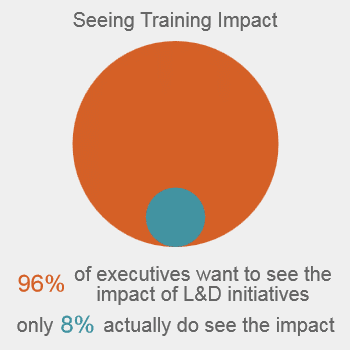
Back in 2010, Jack and Patti Phillips asked CEOs how they measure learning success. Their top answer: business impact. How successful are L&D organizations at proving business impact? Not very, according to the Phillips. Only 8% of the executives they interviewed said they see the impact of their L&D initiatives, but 96% want to see it.
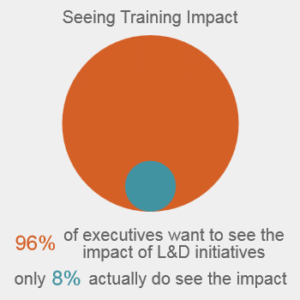
See the Impact of Training - AllenCommThe situation hasn’t changed much since then. Business executives surveyed by Personnel Today ranked career development as a top outcome of training initiatives, but not business impact. In a 2015 poll, ATD found that alignment of learning with business goals was one of the top 3 issues faced by learning organizations.

L&D’s challenge in showing its value with specific, measureable results has bigger consequences. It means that L&D organizations are viewed as reactive, tactical order takers. In fact, according to Bersin, one-fifth of organizations are in that category and fewer than 50% feel they are perceived by their stakeholder leadership as strategic partners.

What are some of the results of this perception?

  • Budget cuts: When times are tough, L&D budgets are some of the first to be cut because there’s a perception that training doesn’t deliver results. It’s not that training doesn’t deliver. It’s that L&D doesn’t make the connection.
  • Fire-drill approach: Because L&D leaders aren’t valued as strategic partners, they aren’t involved in the organization’s strategic planning. This means many business units turn to L&D as a last resort (when the fire is already burning) to fix urgent problems. It’s not that training isn’t successful. It’s that L&D is so busy putting out fires that it doesn’t have the opportunity to measure and document successes.
  • Under-used training: Even in good times, L&D organizations have difficulty attracting enthusiastic learners. According to GoodPractice, two of the biggest challenges facing L&D in 2016 are learner apathy and lack of time for learning. It’s not that training isn’t effective. It’s that L&D hasn’t shown its value.

How can starting with the end in mind help change these perceptions?

  1. Be good at business.

To adapt a quote from Jay Baer, “The goal isn’t to be good at training. The goal is to be good at business because of the training. Measuring training comes down to how well it achieves business goals.”
"The goal isn't to be good at training. The goal is to be good at business because of the training. Measuring training comes down to how well it achieves business goals." Adapted from Jay Baer, Convince and ConvertDuring the planning stage of every new training initiative, be sure you understand fully the business goals driving the project. Answer these questions: How will this project add value to the company? What money will the company make because of this training? Ask your business stakeholders for their answers, too.

For example, if a business unit asks for sales training for account managers, ask questions that allow you to identify the underlying business driver. Is the problem that your account managers are recruited directly from college and lack the business acumen to interact with the C-suite teams who buy your products? Or is it that your company has a new product offering and your sales team doesn’t understand how to differentiate it from your competitors’ offerings? Use a technique such as the 5 Whys to get to the root cause of the problem.

Often training is only one component of a strategic solution such as a new product launch. For a successful launch, the product marketing team will use a full court press that includes marketing, development teams, and more. Align with them on the outcome and uncover the components that require training.

  • How much revenue do they expect the new product to generate?
  • How does the product fit within your company’s strategic objectives?
  • What metrics would constitute success?
  • What percent of the success will L&D contribute?
  • What is the project’s value to the organization?

Get specific. Ask for numbers. Be sure to identify and review all measurements the training solution might impact, effects on other areas, etc. Then, working backward like a CSI expert from bone fragments to a complete person, design a robust training program with those metrics as outcomes.

But tracking to business outcomes isn’t the only solution. It’s time to include new metrics in the mix. And that’s where marketing comes in.

  1. Choose the right metrics for your business.

L&D’s challenge to provide effective metrics doesn’t seem to be a problem of awareness. Kirkpatrick’s 5 levels easily roll off L&D professionals’ tongues, and, as the Phillips point out, ROI certification is now offered globally.

The problem seems to be that we aren’t measuring what matters.

"Consumption metrics are often the easiest for L&D professionals to gather. To make them more valuable, don't stop at just the total numbers; instead, look for trends in the data." Karin Jacobson, AllenCommAccording to marketing metrics gurus like Rebecca Lieb, the most important metric is the one that matters most to your business. As Lieb says, “It makes no difference whatsoever what MY most important content marketing metric is – the real question is: what metric, what key performance indicator is most important to your business? No two marketers’ objectives are exactly alike. What matters is aligning against business goals, not all the abstract things you can measure.”

Lieb’s point applies equally well to L&D. Unfortunately, many L&D professionals focus only on Kirkpatrick Levels 1 and 2—consumption and learner perceptions—metrics senior executives find irrelevant. No measurement framework will be useful unless it ties explicitly with business goals and KPIs. Every time.

For example, how can consumption metrics (think Kirkpatrick’s Level 1) be reframed to connect with business goals? Consumption metrics are often the easiest for L&D professionals to gather. They chart the number of people who have viewed, downloaded, completed, or listened to a training program. To make them more valuable, don’t stop at just the total numbers; instead, look for trends in the data.

  • How is the audience interacting with the training and for how long?
  • How much time are they spending on individual pages?
  • Do patterns vary by learner group?
  • Do you see any patterns between training consumption and business performance?

Do these trends and patterns offer ideas for segmenting the training so it more closely meets learner needs? Do people consuming this training engage in other more desirable behaviors relevant to your business goals? The bottom-line is this: choose your metrics wisely, then go deep, surfacing connections with business outcomes and KPIs.

There’s one final consideration before you begin your project. Learners.

  1. Redefine your learners as customers.

Take a lesson from marketing and see your audience not just as learners, but also as customers.

View training as an opportunity not just to teach, but also to buy new, loyal customers.
"If we treat our learners as potential customers who have to be sold on the value of a product, we are more likely to produce training that actually gets through and changes behavior." Keith Gibson, AllenCommAccording to Keith Gibson’s blog at elearningindustry.com, “If we treat our learners as potential customers who have to be sold on the value of a product, we are more likely to produce training that actually gets through and changes behavior.”

Think of every training project like a marketing campaign using these 3 steps.

  • Awareness: What type of training methods can you use to increase awareness of the project before it even begins, i.e., to bring learners into the funnel?
  • Interest/Evaluation: After they’re in the funnel, how can you increase their enthusiasm about the project and prove your solution will be beneficial to them?
  • Commitment/Repeat: How can you increase learners’ commitment to the L&D organization and their willingness to return for future training and recommend training solutions to their peers?

This shift also changes the types of metrics that will be valuable for explaining L&D’s success. For example, how do successful and enthusiastic learners/customers impact your company’s bottom line by increasing brand awareness and loyalty, improving employee retention and your ability to attract new talent?

By starting with the end in mind, you’ve created a solid foundation for training success. But before you dive wholeheartedly into design and development, we recommend an additional step: a thorough understanding of your audience. You’ve started this analysis already by redefining your learners as customers. Next you’ll need to know how to ensure training changes learners’ behaviors and minds.

Resources For L&D Leaders

free guide

a buyers guide to l&D services
In today’s world, it can be hard to balance learner needs and stakeholder expectations. We want to see you thrive and get the most out of your investments. Snag our free buyer’s guide with the top 5 questions you should ask when looking at potential L&D partners.
get the free guide

free guide

what to look for in onboarding
Effective onboarding begins even before someone’s first day, and it continues months after as the new hire finds their purpose and value within the team. Explore insights into what makes a successful employee experience, and dive deeper into creating meaningful moments that build confidence, behaviors, and affiliation for better outcomes.
get the free guide

This site uses cookies to enhance your browsing experience. These cookies help us understand how you interact with our website, remember your preferences, and improve our services. They also provide insights for analytics and performance tracking across this site and other media. To learn more about the cookies we use, please review our Privacy Policy.

Accept