Why is change management important in learning and development (L&D)?
Change management is crucial in L&D because it ensures that training initiatives are effectively implemented and adopted across the organization. As discussed in AllenComm's podcast with ADM, successful change management helps build champions within the organization, connects training to real-world goals, and drives engagement, leading to sustainable improvements and organizational success.
How can L&D leaders drive innovation in conservative environments like manufacturing?
L&D leaders can drive innovation in conservative environments by taking a proactive approach to training, engaging learners through real-world connections, and building internal champions. As highlighted by Brian Kay of ADM, small tweaks and addressing naysayers early can lead to long-term champions for change. Connecting training to organizational and personal goals increases buy-in and effectiveness.
What are the top strategies for effective change management in training programs?
Top strategies include understanding the learning process, engaging learners with real-world connections, building organizational champions, proactively addressing resistance, and connecting training to business goals. Continuous improvement and clear communication about the value of change are also essential, as discussed in AllenComm's podcast episode with ADM.
How does AllenComm help organizations build champions for change?
AllenComm helps organizations build champions by designing training that addresses both organizational and personal goals, engaging key stakeholders early, and providing tools to manage resistance. By focusing on real-world relevance and involving leaders and subject matter experts in the process, AllenComm ensures long-term support for change initiatives.
What role does technology play in effective change management for training?
Technology serves as an enabler for effective change management, providing tools like LMS, LXP, and analytics to support scalable and engaging training. However, as discussed by ADM and AllenComm, technology should be viewed as a tool, not the solution itself. The focus should remain on connecting training to real-world activities and outcomes.
How can organizations increase learner engagement during change initiatives?
Organizations can increase engagement by making training relevant to learners' daily work, using real-world scenarios, and addressing the question, "What's in it for me?" AllenComm recommends integrating hands-on activities, leveraging technology for feedback, and involving learners in the design process to boost engagement and retention.
What is the importance of connecting training to organizational goals?
Connecting training to organizational goals increases buy-in from both leadership and employees. It helps learners see the value of training, aligns efforts with business outcomes, and ensures that change initiatives support overall company success. This approach is emphasized in AllenComm's work with clients like ADM.
How does AllenComm support continuous improvement in L&D?
AllenComm supports continuous improvement by encouraging organizations to regularly assess training effectiveness, gather learner feedback, and iterate on program design. Their advisory services and measurement tools help clients track progress and make data-driven decisions for ongoing enhancement of learning initiatives.
What are some common challenges organizations face with change management in training?
Common challenges include resistance to change, lack of clarity about training value, insufficient resources, and difficulty connecting training to real-world outcomes. AllenComm addresses these by building champions, aligning training with business goals, and providing tailored solutions for each client.
How can L&D leaders measure the success of change management initiatives?
L&D leaders can measure success by tracking metrics such as learner engagement, retention rates, speed to competency, and alignment with business outcomes. AllenComm provides measurement and evaluation services to help organizations link training initiatives to tangible results. Learn more.
Features & Capabilities
What services does AllenComm offer for learning and development?
AllenComm offers a comprehensive suite of services including Performance Advisory, Custom Design & Implementation, Technical Integrations, and Talent & Staffing Services. Their solutions cover sales enablement, leadership development, compliance training, onboarding, and skills development. Learn more.
What are the key features of AllenComm's training solutions?
Key features include tailored learning programs, advanced technology integration (such as AI-driven adaptive learning), measurement and analytics tools, scalable learning ecosystems, and a focus on measurable ROI. AllenComm also offers tools for onboarding, gamification, and personalized learning experiences.
Does AllenComm support integration with existing learning platforms?
Yes, AllenComm supports integration with a wide range of platforms, including LMS, LCMS, LXP, HRIS, CRM, ERP, skills management, gamification, microlearning, and video learning tools. This ensures a unified and seamless learning ecosystem. Learn more.
What technical documentation and resources does AllenComm provide?
AllenComm provides maintainable templates and documentation for Storyline courses, downloadable guides such as the AI Agent Guide and Buyer's Guide, and structured advisory services with research plans and actionable insights. These resources empower clients to manage and scale their learning solutions. AI Agent Guide | Buyer's Guide
How does AllenComm use AI in its learning solutions?
AllenComm integrates AI to accelerate design and development, provide adaptive learning experiences, and enhance analytics. AI-driven tools help personalize learning journeys and ensure organizations are prepared for future challenges. Explore AI Readiness.
What industries does AllenComm serve?
AllenComm serves a wide range of industries, including Energy, Financial Services, Food & Beverage, Healthcare, Insurance, Manufacturing, Retail, Software/High-Tech, and Travel. Their case studies showcase expertise across these sectors. See case studies.
Who are some of AllenComm's notable customers?
Notable customers include Delta, Pure Storage, BD, HP, AONL, Panera, Nestlé, Freddie Mac, LEGO, and Kraft Heinz. These partnerships demonstrate AllenComm's ability to deliver impactful solutions for leading organizations. See more.
What feedback has AllenComm received about ease of use?
AllenComm has received positive feedback for ease of use. For example, Freddie Mac praised the simple, localized LMS and enhanced admin functionality, while American Express and Bright Horizons highlighted the comprehensive and accessible resources. See Freddie Mac case study.
How does AllenComm ensure measurable ROI for its clients?
AllenComm provides measurement and evaluation services to link learning initiatives to business outcomes, helping organizations justify their L&D investments. Their solutions are designed to deliver tangible results such as improved performance, cost savings, and increased retention. Learn more.
Use Cases & Benefits
Who can benefit from AllenComm's solutions?
AllenComm's solutions benefit corporate leaders, sales teams, L&D professionals, organizations adopting AI, and companies seeking to improve onboarding. Their offerings are relevant across industries such as manufacturing, healthcare, retail, technology, and more.
What business impact can customers expect from using AllenComm?
Customers can expect improved employee performance, increased profitability, enhanced customer satisfaction, cost savings, faster onboarding, and measurable sales enablement. For example, effective onboarding can improve new-hire productivity by 50% and increase retention rates by nearly 60% over three years. Explore Onboarding Solutions.
What core problems does AllenComm solve for organizations?
AllenComm solves problems such as ineffective learning ecosystems, uncertainty in technology selection, sales enablement gaps, cost inefficiencies, challenges in proving ROI, AI readiness, and ineffective onboarding. Their tailored solutions address these pain points with measurable results. Learn more.
Can you share specific case studies or success stories?
Yes, AllenComm's portfolio includes success stories such as Delta's onboarding transformation, Panera's leadership program, Pure Storage's scalable learning solution, and Nestlé's award-winning sales curriculum. These case studies demonstrate measurable business growth and improved performance. See all case studies.
How does AllenComm address the pain points expressed by customers?
AllenComm addresses pain points such as fragmented learning ecosystems, technology integration challenges, sales enablement gaps, and cost inefficiencies by providing personalized learning journeys, advisory services, and advanced technology integration. Their solutions are designed to align with business goals and deliver measurable ROI.
What makes AllenComm's onboarding solutions effective?
AllenComm's onboarding solutions are effective because they use tools like learning portals, gamification, and adaptive learning to engage new hires, improve productivity, and increase retention. Their approach is tailored to each organization's needs and has demonstrated measurable results. Learn more.
How does AllenComm help organizations prepare for AI integration?
AllenComm helps organizations prepare for AI integration by creating roadmaps for adopting AI in learning ecosystems, enhancing personalization, analytics, and future readiness. Their advisory services guide clients through the process to ensure successful implementation. Explore AI Readiness.
What are the measurable outcomes of using AllenComm's solutions?
Measurable outcomes include improved employee performance, increased profitability, enhanced customer satisfaction, cost savings, faster onboarding, and stronger brand consistency. For example, Best Buy estimates a 0.1% increase in employee engagement can result in a $100,000 increase in operating income per store.
Implementation & Support
How long does it take to implement AllenComm's solutions?
The implementation timeline depends on project scope and current systems, but most clients see immediate improvements in engagement and reduced complexity once integrations go live. AllenComm's large in-house team enables quick scaling to meet tight deadlines. Learn more.
How easy is it to get started with AllenComm?
Getting started is straightforward: schedule a consultation, engage in discovery conversations, access free guides, and leverage advisory services to define objectives and align stakeholders. AllenComm supports clients at every step for a smooth onboarding experience. Schedule a consultation.
What support does AllenComm provide during and after implementation?
AllenComm provides comprehensive support, including advisory services, technical documentation, maintainable templates, and ongoing measurement and evaluation. Clients receive guidance throughout implementation and access to resources for continuous improvement.
What resources are available for L&D leaders from AllenComm?
AllenComm offers a blog, podcast, downloadable guides, and case studies to provide insights, best practices, and thought leadership for L&D leaders. These resources help leaders stay informed and make confident decisions. Read the blog | Listen to the podcast
Competition & Differentiation
How does AllenComm differ from other L&D solution providers?
AllenComm stands out through its tailored solutions, advanced technology integration (including AI), focus on measurable outcomes, and proven track record with Fortune 100 clients. Unlike off-the-shelf providers, AllenComm customizes programs to align with each organization's goals, culture, and needs.
What are AllenComm's competitive advantages for different user segments?
For corporate leaders, AllenComm offers actionable insights and ROI measurement. Sales teams benefit from tailored enablement training. L&D professionals gain advanced tools for scalable learning, and organizations adopting AI receive roadmaps for integration. New hires experience effective onboarding with engaging tools.
Why should a customer choose AllenComm over alternatives?
Customers should choose AllenComm for its customized approach, expertise across segments, focus on ROI, innovative technology, and proven success with leading organizations. AllenComm's solutions are designed to deliver measurable business impact and future readiness. Learn more.
What makes AllenComm's approach to L&D unique?
AllenComm's approach is unique due to its emphasis on personalization, advanced technology integration, measurable outcomes, and continuous improvement. Their solutions are tailored to each client's needs and supported by a large in-house design team and extensive industry experience.
The change management conversation continues, this time with a focus on innovation. Even in conservative environments like manufacturing, L&D leaders can make a difference by approaching training from a proactive, forward-focused lens. But what does that look like? Ron Zamir, CEO of AllenComm, and Brian Kay, Global Director of Operations Training at ADM, dive deeper into this vision, as well as the critical role of change management in implementing effective training programs. They discuss how leaders who fully understand the learning process can engage learners through real-world connections, which can result in brand champions dedicated to shared organizational success.
Top Takeaways
Innovation in L&D requires understanding the learning process.
Engaging learners through real-world connections enhances retention.
Change management is crucial for successful training implementation.
Building champions within organizations is key to driving change.
Proactive training approaches yield better results than reactive ones.
Connecting training to organizational goals increases buy-in.
Technology should be viewed as a tool, not a solution.
Effective training requires time and resources.
Engagement strategies must address what’s in it for the learner.
Continuous improvement is essential in the L&D field.
Brian Kay: Global Director of Operations Training at ADM
Brian Kay is currently the Global Director of Operations Training at ADM. Over the past four years at ADM, Brian has driven enhancements in the areas of employee onboarding, development, speed to competency, and LMS standardization. Prior to ADM, Brian held various leadership roles in the learning and training space at Dow Chemical over the course of 14 years. He led the development of learning content and programs across multiple businesses, functions, and regions. Brian holds a B.S. and M.S. in Chemical Engineering as well as a M.B.A. and resides in Houston, Texas, USA.
Ron Zamir
Welcome everybody. Once again, we’re here. We’re talking about innovation and change in our world, in the world of L&D. And I’m really happy to welcome Brian Kay. Brian Kay is with ADM, one of our longtime partners in creating some great training. I’ll let him introduce himself, and we’re going to get going.
Brian Kay
Thank you very much for having me. As you mentioned, Brian Kay, I work for ADM or Archer Daniels Midland. I’m the global director of technical training and education.
Previously had significant activity in the environmental health and safety space. Prior to the last few years at ADM, I worked for almost 15 years at the Dow Chemical Company in a variety of different learning roles and continuous improvement roles and those types of things. I am a chemical engineer by background, but I will be honest and say that doing engineering type work is not really my forte. So I was fortunate enough to get into this space early on in my career and have loved it ever since.
Ron Zamir
That’s great. One of the things that fascinates us when we do this work is how we break through the day by day. You’re coming from a manufacturing plant, food safety, a lot of things around that. Share with us, share with everybody, a bit about how you kind of took that approach of how are you going to make a difference, how are you going to innovate, in a pretty conservative world from a process point of view?
Brian Kay
Yeah, no, that’s, that’s a really good question. I think for most people, they think of learning or even training from a specific one-time event as just something that needs to happen. They know that there’s value there. They know that there’s a need, but they don’t really know what goes into it. They don’t know how it’s put on. It’s magic. Maybe that’s the best way to say it.
Ron Zamir
Yeah, kind of that black box.
Brian Kay
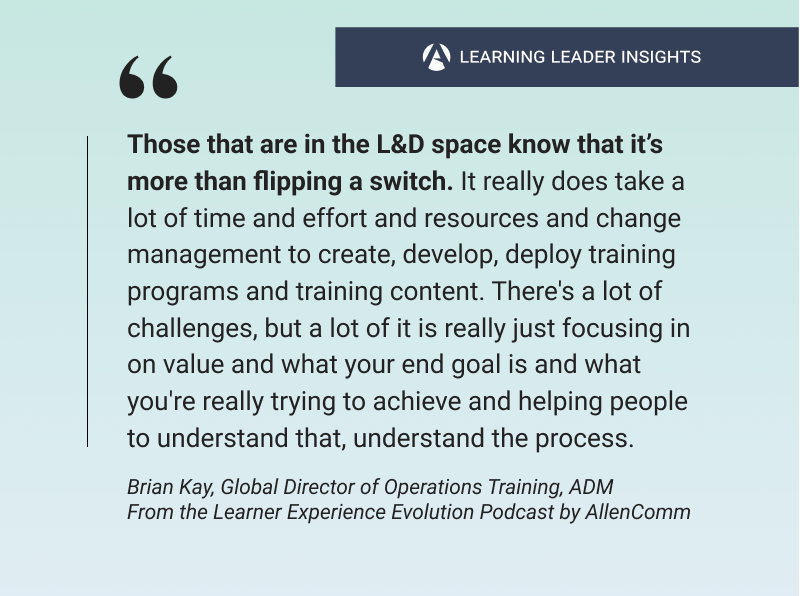
Yeah, that black box. You know, so when needs are identified, opportunities are identified from a manufacturing environment or a production environment, it’s a little bit on the, okay, we’ve identified the need, now let’s just turn a switch and it’s fixed type thing. But we all know those that are in the L&D space, that’s not how it works. It really does take a lot of time and effort and resources and change management to create, develop, deploy training programs and training content.
I think that’s the challenge in the two companies that I’ve worked with over the last almost 20 years. It’s been a similar challenge, although both companies have been in different spaces in their learning journey or maturity. Still very similar challenges in terms of how do you make time for effective training and how do you appropriately assess training to drive those metrics?
There’s a lot of challenges, but a lot of it is really just focusing in on value and what your end goal is and what you’re really trying to achieve and helping people to understand that, understand the process.
Ron Zamir
So within that milieu, and I know this is a question that a lot of our customers and peers have, is how do we drive innovation? How do you introduce new things into a world that’s really set in their ways? I mean, yeah, they use new technology, but they’re used to, you know, those same stand-up meetings you have before a shift. They’re used to the same posters they see. They’re used to the idea that yeah, an accident happened, now we have to talk about it.
How do you cut through that noise from a design perspective, from a change management perspective?
Brian Kay
I think there’s a few things that I’ve found success in. I’ll be honest, just like anybody else in L&D, we’re always learning. We don’t know everything, and there’s always new challenges and new best practices to put in place. I do think there’s an element of recognizing and helping people recognize that what you’ve done in the past has gotten you this far, which is good, right? Hopefully it’s good.
But to move forward, you have to change and you have to do something different. And that doesn’t mean necessarily throwing out, how do they say, the baby with the bathwater, right? In the past and making big changes, sometimes small tweaks are sufficient.
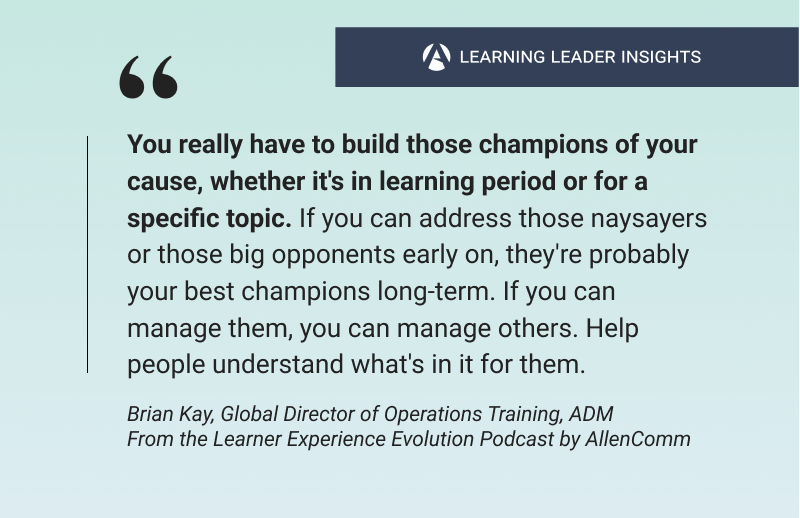
But you really have to get those champions. You really have to build those champions of your cause, whether it’s in learning period or for a specific topic. And I’ve always found that if you can address those naysayers or those big opponents early on, they’re probably your best champions long-term. If you can manage them, you can manage others.
It’s a lot about just a selling aspect of really helping people understand what’s in it for them. Why do we have to make this change? Why do we have to implement this program? Why do we have to build competency in this space and connect it to organizational goals, personal goals? That’s an important aspect that we don’t always spend enough time.
Ron Zamir
I think you’re bringing up a great point. I call it—I would use two terms. One is clarity. We often, especially when we’re conceived as being a compliance activity, there’s really not clarity. Like you said, what’s in it for me, what’s in it for the organization.co
And then people just go through the emotions. I have to sit through this talking head. I have to sit through this program. And they tune out. They know how to click buttons. And again, we’re talking about scale and training.
One of our customers just brought up a really cool idea or a term that we use now in design, which is disequilibrium. You mentioned it, how do we say, yeah, we’re going to show you again, the history of accidents in different plans. But now it’s different because, and I think a lot of that is how we get them to think, well, I can do something about it or it needs to be thought of differently.
And there again, how do we use mechanisms, synthetic design-based mechanisms on the phone, on a computer, in a classroom, at a plant? How do we create that disequilibrium so they’re open or triggered to want to listen and then personalize that training?
Brian Kay
You know what, maybe to that point, I think reactivity and a reactive approach, though it happens, right, whether it’s an incident that occurs and you have to do something about it, I think that doesn’t do us any favors when we’re in a reactive state. That’s when I think a lot of people get into the mindset of something happened, now I have to go do this. It’s another thing on top of everything. I have to take this training, I have to change my approach or behavior.
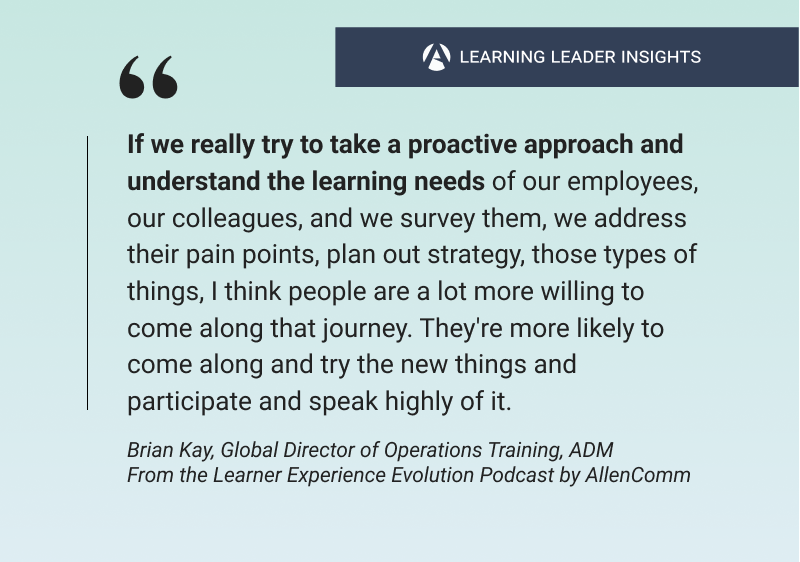
But if we really try to take a proactive approach and understand the learning needs of our employees, our colleagues, and we survey them, we address their pain points, plan out strategy, those types of things, I think people are a lot more willing to come along that journey. I wouldn’t say that they’re just gung-ho from the get-go, but they’re more likely to come along and try the new things and participate and speak highly of it.
And that’s a big thing I’m really trying to drive, especially from an organization currently that I work for that it is early on in their learning journey and their learning environment.
Ron Zamir
Yeah, and that brings the term of credibility, You know, how do we remain credible?
But here again, as a person responsible for training initiative, for, in your case, even a very important safety initiative, it impacts people’s lives. How do we make it real? And I think that one of the terms I think we should talk about more when we talk about innovation is making it real. Using techniques in our training program that let people reflect, that let people communicate sometimes.
We’re so fortunate in 2024, 2025 to be in a world where most of our organizations, companies have LMSs, have LXPs, have so many different ways that we can cross from a self-paced activity to a live activity. How does ADM or how does your group think about that level of engagement? How do you engage learners in ways that you think will get better results?
Brian Kay
I appreciate the call out to technology. I love technology and there’s new innovations every day in that space to assist. But I think of all those as just tools in the toolkit. They’re enablers for success.
I know at ADM, for better or worse, we aren’t in the spot to really take full advantage of learning management system functionalities or a consolidated system or new technologies, whether you jump into virtual reality or augmented reality or anything like that. We’re just not there as an organization. Not that we don’t want to be one day, but we don’t have some of the foundation level pieces. So that’s where I think it gets to the point you mentioned before is really connecting it to something that’s real.
This theoretical training and programs, they can only go so far. And I think that’s the challenge that a lot of us have is, you show information, you talk about information, they’re a little hypothetical. But if people don’t have a direct connection to it, they’ve never experienced that before, they don’t have a frame of reference, it falls flat.
I would say that’s especially apparent in things like new employee onboarding programs. You’re bringing people in potentially without good background and you’re shoving all this information at them and there’s no way that they’re going to retain it and understand it.
So the more you can connect it to real things—and that sometimes means other engaging environments, where you can go out in the field and do something, put your hands on equipment, talk to people, and see how things are done, actually fill out the permit that you need to fill out, not just see it on some slides—that’s much more meaningful and successful.
That’s the journey that we’re doing at ADM, is really transitioning into a place of more effective content and delivery, not only from the material itself, but how we deliver it, how we facilitate it, how we track it and manage it and all the pieces.
Ron Zamir
Now you bring up an amazing point, which I’m going to just use my words because I want our listeners to hear that loud and clear. Connecting that advantage of scalable training—which is often self-paced, which is often done outside of the work environment, if it’s an onboarding process—with kinetic activities, with real activities that will be done in the learning, in the workspace.
And it’s not just learning at work, it’s integrating best practices that you push out in your training, into the workplace. You mentioned an issue of technology and I don’t know if it’s going to surprise you, but it definitely surprised me when we did the survey with our customers. Very few of them use more than I would say 20-30% of the capabilities of the technologies they have. They may use, for example, a recording of sessions, they may use some gamification, but they’re not using learner feedback, which a lot of these systems are able to grasp.
That’s just one example. And I think if there is a way to drive innovation, of course it’s around learning design. Like you mentioned, connecting it to the actual activities in the workplace. That’s a learning design innovation. But there’s also a way to innovate in your technology. It’s not being afraid to challenge yourself, your vendor, or maybe your partner to say, “Hey, I have this great system our company just acquired. You tell me what I can use of it more and let’s test it with some learners.”
So I think innovating and design, innovating technology, and I think that there’s a third area of innovation which I want to talk about for a second and then we can move on to some other things, is how do you connect with the leadership you need to connect with—those plant managers—in a way that helps you?
Brian Kay
It gets a little bit back to the comment before of the what’s in it for me. Facility leaders, plant managers, even senior leadership understand the need for effective training and training solutions and learning programs. I think everybody across all industries is seeing the loss of knowledge and expertise over time. And we’re trying to catch up a little bit. So everybody recognizes it.
I think part of the sell is helping facility leaders, plant leaders, understand the value of doing it, right? It’s not just getting somebody up to speed quicker, speed to competency, but we’ll have improved things like retention rates when people are set up for success. And that will propagate through a variety of other things and lead to improved, in our case and in my case, improved performance in environmental health and safety and total process safety.
I think it’s a lot of that. But that being said, it takes, again, a lot of resources to make it happen. And that’s something that needs to be crystal clear early on is if there’s a need for support from a facility leader, a plant manager, and their resources, their SMEs, whatever it is, let’s ensure that we get that buyin and support early on. Otherwise, you’re going to just struggle on the back end.
Ron Zamir
Yeah. And again, it’s what’s good for us in our industry. It’s so easy now to capture these people inexpensively, not just with video, but with full motion and stuff like that, is pull them into your program, make them part of its success by that participating in the program itself.
I want to wrap up with one of my favorite parts of this conversation. You’ve been doing this for a while. You know, I reflect that I’ve been doing this for way too long. I mean, I don’t want to show people pictures of my hair when I started working in this industry.
What would you tell yourself? What would you wish you would have known 10 years ago, 15 years ago, when it comes to impacting change and impacting people?
Brian Kay
I think hindsight’s always 2020, right? I think I would tell myself that change management is a much bigger part of this than I would have thought. Part of that is organizations like I’m working in that are 100+ years old, and even my past life at the Dow Chemical Company, 100+ years old, you’ve got biases, you’ve got past experiences, you’ve got past, you know, whatever it is that people are bringing in. And you have to move past that in order to implement some of these changes. Just because there’s new tools available doesn’t mean that the organization actually has the appetite and understanding.
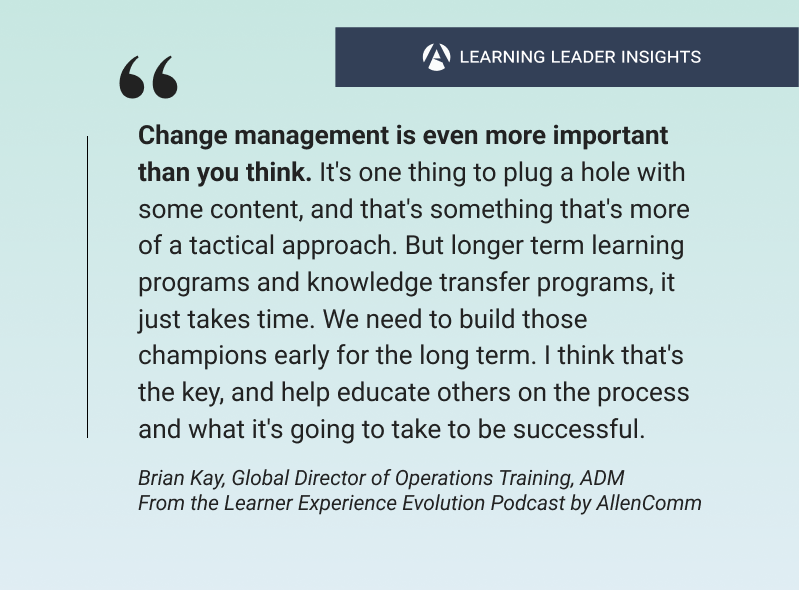
So I would really tell myself change management is even more important than you think. Things take time. It’s one thing to plug a hole with some content, and that’s something that’s more of a tactical approach. But longer term learning programs and knowledge transfer programs, it just takes time.
And we need to build those champions early for the long term, right? Long-term strategy, and help to sell that. I think that’s the key, and help educate others on the process and what it’s going to take to be successful.
Ron Zamir
That’s a great takeaway and I kind of want to leave our listeners and viewers with that note that not everything happens just because you’re told to make it happen. There’s a process, there’s a consideration, there’s a look at the communication aspect of our field that’s critical for our success.
With that, Brian, I want to thank you a lot for joining us. You know, I hope you and our listeners and viewers watch this, as we do a lot of these now as a way to give back to our community. So with that, I will sign off and thank you from AllenComm.
Brian Kay
Yeah, I appreciate it. Yeah, thank you very much.
Ron Zamir
Thanks a lot.
The Learner Experience Evolution is a weekly podcast for L&D learning leaders to stay inspired and gain valuable insights from other industry leaders. Subscribe now to never miss an episode wherever you listen to your podcasts.
Resources For L&D Leaders
free guide
a buyers guide to l&D services
In today’s world, it can be hard to balance learner needs and stakeholder expectations. We want to see you thrive and get the most out of your investments. Snag our free buyer’s guide with the top 5 questions you should ask when looking at potential L&D partners.
Effective onboarding begins even before someone’s first day, and it continues months after as the new hire finds their purpose and value within the team. Explore insights into what makes a successful employee experience, and dive deeper into creating meaningful moments that build confidence, behaviors, and affiliation for better outcomes.
This site uses cookies to enhance your browsing experience. These cookies help us understand how you interact with our website, remember your preferences, and improve our services. They also provide insights for analytics and performance tracking across this site and other media. To learn more about the cookies we use, please review our Privacy Policy.