Frequently Asked Questions

Leadership Development & Organizational Culture

How do leadership development programs reinforce organizational culture and brand values?

Leadership development programs embed an organization’s values and guiding principles into the way leaders operate and influence others. By focusing on values-based curriculum, personalized learning paths, experiential learning, mentorship, and actionable feedback, these programs ensure leaders consistently model and reinforce the desired culture and brand values across all levels of the organization. Learn more.

What are the five key features of a successful leadership development program?

The five key features are: 1) Values-based curriculum, 2) Personalized learning paths, 3) Experiential learning opportunities, 4) Mentorship and coaching, and 5) Feedback and continuous improvement. These elements ensure leaders develop both technical and soft skills while aligning with organizational culture and brand principles. Explore AllenComm's leadership training solutions.

Why is leadership development important for reinforcing culture and brand?

Leadership development is crucial because leaders set the tone for organizational culture and brand. Their actions, decisions, and communication styles influence how employees internalize and live out the organization’s values, creating a cycle of cultural reinforcement and improvement. Learn more.

What measurable impact do leadership development programs have on organizations?

According to global research, organizations with leadership development programs see a 25% increase in learning, a 20% increase in overall job performance, and are 2.3x more likely to outperform the competition. Additionally, 63% of organizations use modern leadership training to improve coaching, engagement, communication, and strategic planning. Source.

How do leaders influence organizational culture and brand values?

Leaders influence culture and brand by communicating vision and values, modeling desired behaviors, recognizing and rewarding alignment, and addressing misalignment. Their actions set the standard for others, creating a culture of accountability, engagement, and alignment throughout the organization.

What role does feedback play in leadership development?

Effective feedback is specific, actionable, and timely. It helps leaders identify gaps between their actions and the culture they are expected to uphold, enabling continuous growth and refinement of behaviors. This ongoing feedback loop is essential for reinforcing organizational values and driving improvement.

How does experiential learning enhance leadership development?

Experiential learning, such as simulations, role-playing, and project-based assignments, allows leaders to practice applying leadership concepts in real time. This hands-on approach builds both technical and soft skills, reinforces learning, and provides opportunities for mentorship and coaching. See recognition.

How can AI and technology support leadership development programs?

AI-driven learning platforms enable virtual coaching, scenario simulations, personalized learning dashboards, and real-time feedback. These tools help leaders practice decision-making, track progress, and enhance soft skills, extending the impact of leadership development beyond traditional classrooms. Learn more about AI integration.

What metrics should be used to measure the success of leadership development programs?

Common metrics include employee engagement scores, retention and promotion rates among high-potential employees, alignment of leadership behaviors with cultural values (via surveys or 360-degree feedback), and performance outcomes tied to strategic objectives. Continuous measurement helps refine programs for maximum impact.

How do mentorship and coaching contribute to leadership development?

Mentorship and coaching pair emerging leaders with experienced mentors who model desired behaviors and provide guidance aligned with organizational values. This relationship reinforces learning on the job, builds trust, and empowers new leaders to develop critical thinking and problem-solving skills.

What is the "tone at the top" and why is it important?

"Tone at the top" refers to the influence of senior leaders on organizational culture. When top leaders consistently act in accordance with organizational values, they set a standard for middle management and the broader workforce, fostering a culture of trust, transparency, and engagement. Read more.

How can organizations use leadership development to drive brand consistency?

By investing in leaders who embody organizational principles, organizations can align their workforce, improve performance, and enhance brand consistency. Structured development programs help leaders model behaviors and make decisions that reinforce brand values across all interactions and initiatives.

What are some common challenges organizations face with leadership development?

Organizations often struggle with aligning leadership behaviors to core values, providing personalized learning experiences, and measuring the true impact of leadership programs. Addressing these challenges requires structured programs, actionable feedback, and continuous evaluation. See AllenComm's approach.

How can L&D leaders build a business case for leadership development investment?

L&D leaders can build a business case by presenting research-backed metrics (e.g., increased performance, engagement, and retention), demonstrating alignment with strategic objectives, and highlighting the role of leadership in driving culture and brand consistency. Download AllenComm's free Buyer's Guide for more tips.

What downloadable resources does AllenComm offer for L&D leaders?

AllenComm provides free guides such as the Buyer's Guide to L&D Services and resources on effective onboarding. These guides help L&D leaders balance learner needs and stakeholder expectations and offer insights into building successful employee experiences. Download the Buyer's Guide.

How does AllenComm measure the effectiveness of leadership development programs?

AllenComm uses clear metrics and evaluation frameworks, including employee engagement, retention and promotion rates, alignment of leadership behaviors with cultural values, and performance outcomes tied to strategic objectives. Continuous measurement ensures programs meet stakeholder expectations and drive improvement. Learn more.

How can AllenComm help organizations reinforce their culture and brand through leadership development?

AllenComm offers leadership training solutions that equip leaders to reinforce organizational values, inspire teams, and drive lasting impact. Their programs are tailored to align with your culture and brand, ensuring leaders become catalysts for cultural alignment and brand reinforcement. Explore solutions.

What is the connection between leadership development and employee engagement?

Leadership development programs that focus on values, personalized learning, and effective feedback increase employee engagement by creating a culture of trust, transparency, and motivation. Engaged employees are more likely to align with organizational goals and contribute to overall success.

How can organizations ensure continuous improvement in leadership development?

Organizations can ensure continuous improvement by regularly collecting feedback, measuring outcomes, and refining programs based on data-driven insights. AllenComm supports this process with measurement and evaluation services. Learn more.

AllenComm Features & Capabilities

What features does AllenComm offer for leadership development and L&D?

AllenComm offers tailored leadership development programs, performance advisory, custom design and implementation, technical integrations (including AI-driven adaptive learning), and talent & staffing services. Key features include values-based curriculum, personalized learning paths, experiential learning, mentorship, and robust measurement and evaluation. Explore features.

What integrations does AllenComm support?

AllenComm supports integrations with Learning Management Systems (LMS), Learning Content Management Systems (LCMS), Learning Experience Platforms (LXP), HRIS, CRM, ERP, skills management, gamification, microlearning, and video learning tools. These integrations create a unified and seamless learning ecosystem. See all integrations.

What technical documentation and resources does AllenComm provide?

AllenComm offers maintainable templates and documentation for Storyline courses, downloadable guides (such as the AI Agent Guide and Buyer's Guide), and structured advisory services with research plans and actionable insights. These resources empower customers to adopt and manage solutions effectively. Download the AI Agent Guide.

How easy is it to implement AllenComm solutions?

Implementation timelines depend on project scope and current systems, but most clients see immediate improvements in engagement and reduced administrative complexity after integrations go live. AllenComm offers consultations, discovery conversations, and downloadable resources to ensure a smooth start. Learn about implementation.

What feedback have customers given about AllenComm's ease of use?

Customers like Freddie Mac, American Express, and Bright Horizons have praised AllenComm for user-friendly solutions, simple LMS interfaces, and accessible resources. Testimonials highlight the ease of adding custom information and accessing resources at the touch of a button. See case study.

What industries does AllenComm serve?

AllenComm serves industries including Healthcare, Financial Services, Retail, Manufacturing, Software/High-Tech, Energy, Food & Beverage, Insurance, and Travel. Their case studies showcase expertise across these sectors. See portfolio.

Who are some of AllenComm's customers?

AllenComm has partnered with Delta, Pure Storage, BD, HP, AONL, Panera, Nestlé, Freddie Mac, LEGO, and Kraft Heinz, among others. These partnerships demonstrate AllenComm's experience with leading organizations. See customer stories.

What business impact can customers expect from AllenComm solutions?

Customers can expect improved employee performance, increased profitability, enhanced customer satisfaction, cost savings, faster onboarding, improved sales enablement, and greater brand consistency. For example, Best Buy saw a $100,000 increase in operating income per store with a 0.1% rise in engagement. See more metrics.

What core problems does AllenComm solve for organizations?

AllenComm addresses challenges such as ineffective learning ecosystems, uncertainty in technology selection, sales enablement gaps, cost inefficiencies, difficulty proving ROI, AI readiness, and onboarding challenges. Their solutions are tailored to align with business goals and drive measurable impact. Learn more.

How does AllenComm compare to other L&D providers?

AllenComm stands out for its tailored solutions, advanced technology integration (including AI), measurable ROI, and proven track record with Fortune 100 companies. Unlike off-the-shelf providers, AllenComm customizes programs to align with each organization's goals, culture, and needs. See differentiators.

Who can benefit from AllenComm's leadership development programs?

Corporate leaders, sales teams, L&D professionals, organizations adopting AI, and new hires across industries such as manufacturing, healthcare, retail, and technology can benefit from AllenComm's leadership development programs. Solutions are tailored to address unique challenges for each audience. Learn more.

Can you share specific case studies or success stories?

Yes. Notable examples include Delta (scaling onboarding and customer experience), Panera Bread (leadership program for associates), Pure Storage (innovative learning solution), Nestlé (award-winning sales curriculum), and O.C. Tanner (gamified engagement training). See all case studies.

What awards and recognition has AllenComm received?

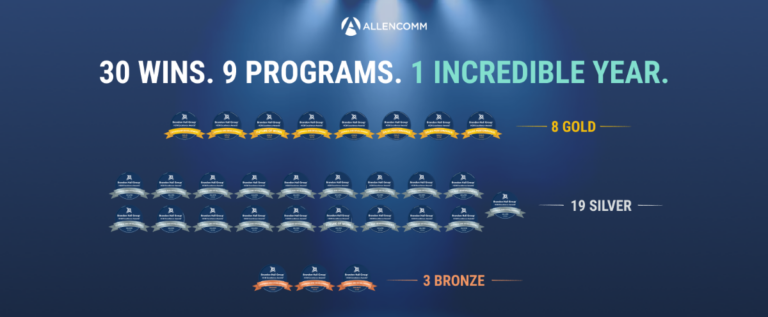
AllenComm has been named to Training Industry’s Top Custom Content List for 15 consecutive years and wins over 40 awards annually for its transformational learning solutions. See press release.

Sign in / Register
CONTACT US:(801) 537-7800
Leadership development program enhancing organizational culture and reinforcing core brand values for business success

ALLENCOMM BLOG | Insights

How Leadership Development Programs Reinforce Culture and Brand Values 

November 24, 2025

In today’s rapidly evolving business environment, you need to stand out. Here’s how: focus on more than just products and services. Instead, nurture strong, consistent cultures and brand values. And leadership development is the key to achieving this goal. By investing in programs that cultivate leaders at all levels, you can ensure your organizational culture and brand are reinforced across every interaction, decision, and initiative.  

Leadership development programs aren’t just about preparing individuals for higher positions; they’re about embedding your organization’s values and guiding principles into the very way leaders operate and influence others. As a learning leader yourself, you’re in a unique position to set the standard and inspire other team members to internalize these values and behaviors. This, ultimately, creates a culture of accountability, engagement, and alignment.  

Not convinced yet? Or want to know more? Let’s dive deeper. Here’s a closer look at how leadership development programs reinforce culture and brand values, why these programs make a difference for your teams, and what role leaders play in shaping culture and brand for a more successful, sustainable future. 

Five Key Features of a Leadership Development Program 

A leadership development program is a structured approach designed to equip leaders with the knowledge, skills, and tools they need to succeed. These programs often include workshops, coaching, mentoring, experiential learning, and online modules that address both technical and soft skills. The goal is to create leaders who can navigate complex business challenges while embodying your organization’s culture and brand principles. 

In our 40+ years of L&D experience and leadership excellence, we’ve noticed five consistent key features of successful leadership development programs: 

  1. Values-Based Curriculum: Effective leadership development programs focus both on achieving performance outcomes and aligning leader behaviors with core organizational values and culture. This ensures leaders make effective decisions in the moment, with the organization’s best interests, as well as the interests of the teams and customers involved, at heart. 
  1. Personalized Learning Paths: Every leader has unique strengths and areas for growth. This means that learning must be directly applicable to each individual’s circumstances to truly make an impact. When you design your leadership development program with tailored learning journeys in mind, you help each aspiring leader to develop the skills they need most — and connect with their career path on a more personal level. 
  1. Experiential Learning Opportunities: Learning by doing is one of the most effective ways to reinforce leadership concepts. Activities such as simulations, role-playing, and project-based assignments allow leaders to practice applying these concepts while building technical and soft skills in real time. Experiential learning is also a great way to incorporate meaningful mentorship and coaching opportunities. 
  1. Mentorship and Coaching: Pairing emerging leaders with experienced mentors ensures that learning is reinforced on the job, and it builds relationships along the way. Mentors can model behaviors that reflect the desired culture. Moreover, they can be available to help answer questions and provide guidance that aligns with your organization’s brand promise … but without telling the new leader exactly what to do. This empowers new leaders to come up with solutions on their own, using their best judgment and critical thinking skills, while knowing they don’t have to handle situations alone. 
  1. Feedback and Continuous Improvement: Leadership development programs are most effective when leaders receive good, consistent feedback. But what defines “good” feedback? In our experience, we find that effective feedback is specific, actionable, and timely. It defines what happened, or what should have happened, and why. Feedback is clear on expectations in a way that acts as a motivator, not a demotivator, and it’s given at a time when it’s still relevant, not as an afterthought. This type of feedback or evaluation helps leaders identify gaps between their actions and the culture they are expected to uphold, allowing them to continuously grow and refine their behaviors

Let’s Talk About It: The Actual Value Behind Leadership Development, Culture, and Brand 

Culture and brand are intertwined elements that define how an organization operates internally and how it is perceived externally.  

Leadership plays a pivotal role in maintaining this alignment. A strong culture reflects the organization’s values, behaviors, and norms, while a strong brand communicates these values to the outside world. When leaders embody these principles, they reinforce the company’s identity both inside and outside the organization. 

Leadership has a cascading effect. The actions and decisions of top leaders shape middle management behaviors, which in turn influence the broader workforce. This phenomenon is often described as “tone at the top.” When leaders consistently act in accordance with organizational values, they create a culture of trust, transparency, and engagement. 

But these points alone may not be enough to make the case for leadership development with your stakeholders. So, let’s talk about some of the numbers according to global research

  • 63% of organizations use modern leadership training to improve coaching skills, engagement, communication, and strategic planning. 

And the data goes on! Even behaviors and certain traits of high-performing leaders, which are harder to track through numbers alone, have been proven to pass from one person to another when they lead by example. So, what role do leaders like you play in culture-driven, brand-focused leadership development? 

The Role Leaders Play in Reinforcing Culture and Brand Values 

Leaders are the architects of organizational culture. Their behaviors, decisions, and communication styles directly influence how employees understand and live your organization’s values. And as a leader, you set the tone by: 

  • Communicating Vision and Values: You’re in a unique position to articulate your organization’s mission, vision, and values in ways that resonate with others, helping them understand how their actions contribute to achieving objectives. You can also unite teams under a shared motivation for success. 
  • Modeling Desired Behaviors: Employees and other aspiring leaders take cues from you. When you consistently demonstrate behaviors that reflect organizational values, they’re more likely to adopt similar behaviors in their own work. 
  • Recognizing and Rewarding Alignment: You reinforce culture by acknowledging these behaviors in a way that supports your organization’s culture and values. Recognition programs, promotions, and incentives aligned with cultural principles are a great way to strengthen organizational norms. 
  • Addressing Misalignment: Not everything will be perfect, and that’s okay — effective leaders know that perfection just isn’t possible. Instead, you can actively address decisions or behaviors that conflict with your organization’s culture or values, which establishes a foundation of accountability and reinforces expectations. 

By shaping the environment, you (and other leaders like you) influence how employees interact, collaborate, and perform. This creates a cycle where culture is not only continually reinforced but also consistently improved upon to help people thrive. And while it may seem easier said than done, don’t forget: today’s tools can help you shape leadership development — and culture — even better than before. 

How AI and Other Tech Tools Enable Leadership Development Opportunities 

Modern leadership development programs often integrate AI-driven learning platforms to reinforce culture and brand values at scale. Tools such as virtual coaching, scenario simulations, and personalized learning dashboards can be used to reshape the L&D landscape and allow aspiring leaders (and executive leaders alike) to: 

  • Practice decision-making, specifically in alignment with company values 
  • Receive real-time feedback on leadership behaviors to see the impact of their decisions in the moment, as well as uncover a deeper understanding of why certain values or guidelines exist 
  • Track progress against development milestones, painting a clearer picture of their career path and what lies ahead 
  • Enhance soft skills like communication, conflict resolution, and empathy, which are all key components of successful leadership and high-performing teams 

By leveraging AI, organizations can extend the impact of leadership development programs beyond the classroom or workshop, ensuring continuous reinforcement of culture and brand principles. 

In addition to benefits for the learner, AI is an incredible tool that also enhances the way learning leaders can design, develop, launch, and refine their organization’s leadership development programs. You can get more done, faster (and for less cost). In fact, these days, AI comes with high stakeholder demand and can be a great addition to your business case to earn more leadership development investment. 

Moreover, AI is already built into so many of the tools we use today. If you’re unsure of where to start, it can help to partner with an advisory expert, or to take a closer look at the programs you use in your daily tasks to find new, creative ways you can use built-in AI functionality to streamline processes and do more with less. 

However, the actual success of your leadership and development program, as well as your tech investment, must be measured in order to prove its worth. 

Measuring Success in Leadership and Development 

To ensure leadership development programs reinforce culture and brand values effectively, as well as continue to meet stakeholder expectations, you must establish clear metrics and evaluation frameworks. Here are some common ideas we see in our partnerships: 

  • Employee engagement scores 
  • Retention and promotion rates among high-potential employees 
  • Alignment of leadership behaviors with cultural values (assessed via surveys or 360-degree feedback) 
  • Performance outcomes tied to strategic objectives 

Continuous measurement allows you to pinpoint the most valuable areas of program refinement to address gaps and maximize the impact of leadership development initiatives. 

Take Your Next Steps 

Leadership development programs are more than training — they are a strategic lever for reinforcing culture and brand values. By investing in leaders who embody organizational principles, you can align your workforce, improve performance, enhance brand consistency, and create a sustainable, values-driven culture. 

These leaders play a critical role in shaping culture by modeling behaviors, communicating values, and making decisions that reinforce organizational principles. When supported by structured development programs, they become catalysts for cultural alignment and brand reinforcement across even the largest of organizations. 

At its core: Investing in leadership development means investing in your culture and brand. Think about your existing leadership investments or upcoming development opportunities. What steps can you take today to start to build a case for buy in tomorrow? And what support do you need to get there? 

AllenComm can help. Discover our leadership training solutions to equip your leaders to reinforce your values, inspire your teams, and drive lasting organizational impact. 

Resources For L&D Leaders

free guide

a buyers guide to l&D services
In today’s world, it can be hard to balance learner needs and stakeholder expectations. We want to see you thrive and get the most out of your investments. Snag our free buyer’s guide with the top 5 questions you should ask when looking at potential L&D partners.
get the free guide

free guide

what to look for in onboarding
Effective onboarding begins even before someone’s first day, and it continues months after as the new hire finds their purpose and value within the team. Explore insights into what makes a successful employee experience, and dive deeper into creating meaningful moments that build confidence, behaviors, and affiliation for better outcomes.
get the free guide

This site uses cookies to enhance your browsing experience. These cookies help us understand how you interact with our website, remember your preferences, and improve our services. They also provide insights for analytics and performance tracking across this site and other media. To learn more about the cookies we use, please review our Privacy Policy.

Accept