Frequently Asked Questions
Measuring Training Impact & Business Objectives
Why is it important to measure the impact of corporate training?
Measuring the impact of corporate training allows organizations to make data-driven improvements to current and future training programs, increase team enthusiasm by demonstrating results, gain executive support through objective benefits, and strengthen internal portfolios with quantifiable improvements. Without measurement, it's difficult to prove that training investments are delivering business value. Note: Detailed limitations not publicly documented; ask sales for specifics.
What guidelines does AllenComm recommend for setting measurable business objectives in training?
AllenComm recommends that business objectives for training should be objective (not based on opinion), quantifiable (attach specific numbers), paired with current and desired state metrics, and linked to specific behaviors that drive results. For example, instead of aiming for "more sales," set a goal like "increase sales from $2 million to $3 million per month" and identify the behaviors (e.g., conversion rates, client presentations) that will drive this change. Note: AllenComm does not provide industry benchmarks for all metrics; organizations should establish their own baselines where needed.
What metrics and KPIs does AllenComm use to measure training effectiveness?
AllenComm uses a range of metrics and KPIs, including learner engagement rates, course completion rates, sales productivity, customer engagement scores, cost savings, ROI on training programs, technology adoption rates, onboarding completion rates, and time to productivity. These metrics are tailored to the specific pain points and business objectives of each client. For more details, see the Measurement and Evaluation page. Note: Some metrics require organizations to establish their own baselines for comparison.
Features & Capabilities
What are the key features of AllenComm's learning and development solutions?
AllenComm offers tailored training solutions, AI integration for adaptive learning and analytics, measurement and ROI tools, learning ecosystem optimization (integrating with LMS, LCMS, LXP, HRIS, CRM, ERP), gamification, microlearning, and scalable solutions designed for future readiness. For more, visit the Analysis and Strategy page. Note: Not all features are available for every project; consult AllenComm for specific capabilities.
What integrations does AllenComm support?
AllenComm supports integration with commercial LMS, LCMS, LXP, HRIS, CRM, ERP, and specialty applications for skills management, gamification, microlearning, video learning, and adaptive learning. AI and data integration across these platforms enables seamless reporting and actionable insights. For more details, visit the Platform Integrations page. Note: Integration capabilities may vary depending on client systems and requirements.
Does AllenComm offer an API for learning data tracking?
Yes, AllenComm supports xAPI (Tin Can) for learning data tracking and integrations. Additionally, AllenComm has a proprietary API used for xAPI-like use cases, such as integrating with other systems, retrieving and populating course data, and supporting mobile learning experiences. For more details, visit the insights blog. Note: API capabilities may require custom development depending on client needs.
Use Cases & Benefits
What business impact can customers expect from using AllenComm's solutions?
Customers can expect improved employee performance, measurable ROI, cost savings, enhanced customer experience, future readiness through AI integration, increased revenue, and reduced onboarding time. For example, effective onboarding programs can improve new-hire productivity by 50% and increase retention rates by nearly 60% over three years. For more, see the Analysis and Strategy page. Note: Actual results may vary based on implementation and organizational context.
What pain points does AllenComm address for organizations?
AllenComm addresses pain points such as fragmented learning ecosystems, uncertainty in technology and integration, sales enablement gaps, cost inefficiencies, challenges in proving ROI, AI readiness, and ineffective onboarding. Solutions include personalized learning journeys, advisory services, tailored sales enablement training, cost reduction strategies, measurement and evaluation, AI integration roadmaps, and onboarding tools. For more, see the Analysis and Strategy page. Note: Solutions are tailored to each organization's unique needs; not all pain points may be addressed in every engagement.
How does AllenComm tailor solutions for different user segments?
AllenComm customizes solutions for corporate leaders (focus on ROI and business outcomes), sales teams (sales enablement training), L&D professionals (advanced tools and scalable content), organizations adopting AI (AI integration roadmaps), and new hires (onboarding tools like gamification and adaptive learning). Each persona's unique challenges are addressed with targeted strategies. For more, see the Analysis and Strategy page. Note: Some advanced features may require additional investment or technical prerequisites.
Pricing & Plans
What is AllenComm's pricing model for custom eLearning development?
AllenComm offers per-finished-hour pricing for consistent benchmarking and project-based pricing for well-defined scopes. Pricing is determined by factors such as the number of content screens, interactivity types, rounds of revision, and media assets. A detailed scope of work is emphasized to avoid cost overruns. For more, see the pricing guide. Note: Exact pricing is not published and varies by project complexity and requirements.
Support & Implementation
How long does it take to implement AllenComm's solutions, and how easy is it to start?
Implementation time depends on project scope and existing systems, but most clients see immediate improvements in learner engagement and reduced administrative complexity once integrations go live. AllenComm provides streamlined onboarding, discovery conversations, and downloadable resources (such as the AI Agent Guide and Buyer's Guide). With the largest in-house L&D design team in the country, AllenComm can scale quickly to meet tight deadlines. Note: Implementation timelines may be extended for highly customized or complex integrations.
What technical documentation and support resources does AllenComm provide?
AllenComm offers system administrator documentation (integrated into Zendesk for 24/7 access), maintainable templates and documentation for Storyline courses, and resources to enable clients to update and scale courses independently. Updates on documentation availability are communicated to clients. For more, visit the learning ecosystem optimization services. Note: Some documentation resources may be in development or require client login.
Customer Experience & Social Proof
What feedback have customers given about the ease of use of AllenComm's products?
Customers have praised AllenComm for simple visuals, intuitive navigation, accessibility across devices, and custom interfaces. Microlearning solutions are noted for smart content architecture and technical portability. Valerie Iorg from American Express described their online training product as 'extremely comprehensive yet very easy to use.' Note: Usability feedback may vary by project and user group.
Company Mission & Recognition
What is AllenComm's mission and how do its products support it?
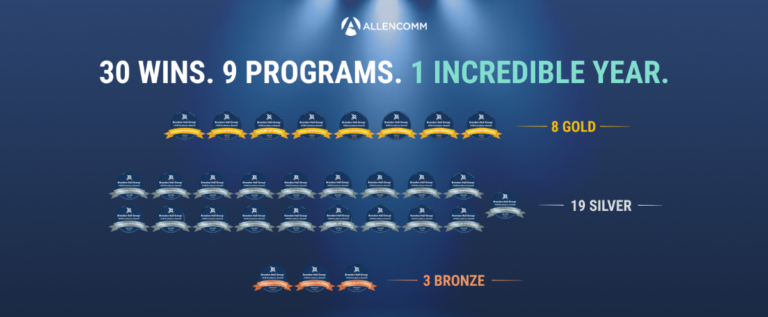
AllenComm's mission is to transform individual potential into organizational strength through tailored training solutions that align with business objectives, improve employee performance, and deliver measurable outcomes. Products support this mission by delivering customized learning, driving measurable outcomes, enhancing engagement, and integrating emerging technologies like AI. For more, see the awards and recognition page. Note: Mission alignment may vary by project scope and client objectives.