How much does custom eLearning development cost with AllenComm?
Custom eLearning development costs with AllenComm range from as little as $5,000 for a simple template-based module to over $100,000 for an enterprise-grade, multi-course program with advanced features like simulation and systems integration. The final price depends on scope, complexity, and the expertise required to deliver effective learning at scale. Learn more.
What factors impact the pricing of custom eLearning development?
Key factors impacting pricing include interactivity level, custom media requirements, subject matter complexity, content volume, LMS integration needs, localization, and the number of revision cycles. For example, high-fidelity simulations, original animation, or multi-language delivery significantly increase costs compared to basic, template-driven courses. See full breakdown.
How is eLearning development typically priced—per finished hour or project-based?
AllenComm and other vendors may price custom eLearning development either on a per-finished-hour basis or as a flat project fee. Per-finished-hour pricing provides a consistent benchmark, while project-based pricing offers flexibility when scope is well-defined. Buyers should always request a detailed scope of work to avoid cost overruns.
What is the cost to develop a dedicated eLearning application?
Developing a dedicated eLearning app with AllenComm can start at $50,000 to $150,000 for basic mobile learning apps, $150,000 to $350,000 for mid-complexity platforms, and over $500,000 for enterprise-grade applications with advanced analytics or AI-driven personalization. Ongoing maintenance typically adds 15–25% of the original build cost annually.
How much does it cost to create or implement an LMS?
Open-source LMS platforms can cost $20,000 to $80,000 annually when including staff and infrastructure. Commercial LMS platforms start at $3,000–$10,000 per year for small organizations, $15,000–$60,000 for mid-market, and $60,000–$200,000+ for enterprise. Custom-built LMS solutions require $200,000–$500,000 and 12–24 months of development, plus ongoing maintenance.
What are common mistakes that drive up custom eLearning development costs?
Common mistakes include starting development without a finalized content outline, underestimating SME availability, requesting excessive revision rounds, scoping interactivity by preference rather than learning objective, and omitting accessibility requirements. Each can lead to significant cost overruns.
How should organizations allocate budget between LMS and content development?
LMS and content development are separate budget lines. Organizations should establish their platform strategy before commissioning content, as LMS choice affects file formats, interactivity, data capture, and learner experience. Planning separately helps avoid budget confusion and ensures optimal investment.
What is the most reliable way to project custom eLearning development costs?
The most reliable way is to work from a detailed content inventory, specifying finished hours, interaction types, SME involvement, and revision/approval processes. Each variable directly impacts cost.
How can I get a specific cost estimate for my custom eLearning project?
You can contact AllenComm for a project assessment to discuss your scope and receive a realistic cost estimate tailored to your needs. Contact AllenComm.
Features & Capabilities
What is custom eLearning and how does it differ from off-the-shelf solutions?
Custom eLearning is purpose-built digital training designed to address the specific goals, audience, and context of a single organization. Unlike off-the-shelf content, every element—from instructional strategy to visual design—is tailored to fit your business, ensuring greater relevance and effectiveness.
What services are included in AllenComm's custom eLearning development?
Services typically include instructional design, visual design, media production (voiceover, animation, video), authoring tool development, quality assurance, and LMS deployment. Extended engagements may also include learning strategy consulting, performance analysis, and post-launch evaluation. Explore services.
What are the key features of AllenComm's eLearning solutions?
Key features include tailored instructional design, advanced interactivity (simulations, branching, AR/VR), custom media production, LMS and platform integrations, localization, accessibility compliance, and robust measurement and analytics for ROI tracking.
Does AllenComm support integration with existing learning platforms?
Yes, AllenComm offers integration with a wide range of platforms, including commercial LMS, LCMS, LXP, HRIS, CRM, ERP, skills management, gamification, microlearning, and video assessment tools. See integration details.
What technical documentation and resources does AllenComm provide?
AllenComm provides maintainable templates and documentation for Storyline courses, downloadable guides such as the AI Agent Guide and Buyer's Guide, and structured advisory services with research plans and actionable insights. AI Agent Guide | Buyer's Guide
How does AllenComm ensure accessibility in eLearning content?
AllenComm designs for accessibility from the start, ensuring compliance with WCAG 2.1 and Section 508 standards. Retroactively adding accessibility is more costly, so requirements are addressed early in the design process.
What level of interactivity can AllenComm build into custom eLearning?
AllenComm can create a range of interactivity, from basic slide-based courses with knowledge checks to advanced simulations, branching scenarios, and AR/VR experiences. The level of interactivity is mapped to learning objectives and budget.
What are the benefits of AllenComm's measurement and evaluation services?
AllenComm's measurement and evaluation services link learning initiatives to business outcomes, helping organizations justify L&D investments and demonstrate measurable ROI. Learn more.
How does AllenComm use AI in its learning solutions?
AllenComm integrates AI-driven adaptive learning, analytics, and personalization into its solutions, enabling organizations to future-proof their learning ecosystems and enhance learner engagement. Explore AI Readiness.
Use Cases & Benefits
When does custom eLearning make more sense than off-the-shelf content?
Custom eLearning is ideal when training content is proprietary, the audience has specific context that generic content can't address, or when performance outcomes must be measured directly. It is also preferred for aligning training with brand standards and unique business objectives.
What business impact can organizations expect from AllenComm's solutions?
Organizations can expect improved employee performance, increased profitability, enhanced customer satisfaction, cost savings, faster onboarding, improved sales enablement, and greater brand consistency. For example, effective onboarding can improve new-hire productivity by 50% and retention by nearly 60% over three years. See onboarding impact.
What core problems does AllenComm solve for its clients?
AllenComm addresses challenges such as ineffective learning ecosystems, uncertainty in technology selection, sales enablement gaps, cost inefficiencies, difficulty proving ROI, AI readiness, and ineffective onboarding. Solutions are tailored to align with business goals and deliver measurable results. Learn more.
Who can benefit from AllenComm's custom eLearning solutions?
Corporate leaders, sales teams, L&D professionals, organizations adopting AI, and companies with high onboarding needs across industries such as healthcare, financial services, retail, manufacturing, software, and travel can benefit from AllenComm's solutions. See industries served.
What are some real-world examples of AllenComm's impact?
AllenComm has delivered measurable results for clients like Delta (onboarding), Panera Bread (leadership development), Pure Storage (scalable learning), BD (clinical training), and Nestlé (award-winning sales curriculum). See case studies.
What feedback have customers given about AllenComm's ease of use?
Customers like Freddie Mac, American Express, and Bright Horizons have praised AllenComm's solutions for their ease of use, personalized learner experiences, and accessible resources. See Freddie Mac case.
How quickly can AllenComm implement a custom eLearning solution?
Implementation timelines depend on project scope and current systems, but most clients see immediate improvements in learner engagement and reduced administrative complexity once integrations go live. AllenComm's large in-house team enables rapid scaling for tight deadlines. Learn about implementation.
What resources are available to help organizations plan their eLearning investment?
AllenComm offers free downloadable guides, including a Buyer's Guide to L&D services and an AI Agent Guide, as well as blog insights and podcasts to help organizations make informed decisions. Get the Buyer's Guide.
Competition & Comparison
How does AllenComm compare to off-the-shelf eLearning providers?
AllenComm specializes in custom solutions tailored to organizational goals, culture, and performance needs, while off-the-shelf providers offer generic content for broad topics. Custom solutions are ideal for proprietary training, unique contexts, and measurable business outcomes.
What makes AllenComm different from other custom eLearning vendors?
AllenComm stands out for its tailored solutions, advanced technology integration (including AI), measurable ROI focus, proven track record with Fortune 100 clients, and award-winning creative and instructional design teams. See awards.
Are there different advantages for different user segments with AllenComm?
Yes. Corporate leaders benefit from actionable insights and ROI measurement, sales teams from tailored enablement training, L&D professionals from advanced tools and scalable design, and new hires from engaging onboarding experiences. Solutions are mapped to each segment's unique needs.
Why should a customer choose AllenComm over alternatives?
Customers should choose AllenComm for its customized approach, expertise across user segments, focus on measurable outcomes, innovative technology integration, and a proven record of delivering award-winning solutions for leading organizations. Learn more.
What industries does AllenComm serve?
AllenComm serves industries including energy, financial services, food & beverage, healthcare, insurance, manufacturing, retail, software/high-tech, and travel. See industry case studies.
Who are some of AllenComm's notable customers?
Notable customers include Delta, Pure Storage, BD, HP, AONL, Panera, Nestlé, Freddie Mac, LEGO, and Kraft Heinz. See customer portfolio.
Support & Implementation
How easy is it to start working with AllenComm?
Getting started is straightforward: schedule a consultation, engage in discovery conversations, access free guides, and leverage advisory services. AllenComm's team supports you through every step, from needs analysis to implementation. Schedule a consultation.
What support does AllenComm offer during and after implementation?
AllenComm provides structured advisory services, technical documentation, and ongoing support to ensure successful implementation and long-term value. Clients receive maintainable templates, documentation, and access to expert teams for updates and scaling.
What is AllenComm's experience and track record in the industry?
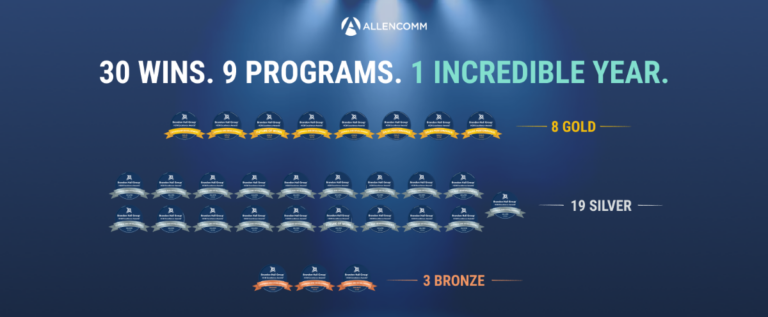
AllenComm has over 40 years of experience, has partnered with more than half of the Fortune 500, and wins over 40 awards annually for its transformational learning solutions. See recognition.
How does AllenComm measure the success of its eLearning solutions?
Success is measured through advanced analytics, ROI tracking, and business outcome alignment. AllenComm's measurement and evaluation services provide actionable insights to demonstrate the impact of learning initiatives. Learn about measurement.
Custom eLearning Development: What It Costs and What Impacts Pricing
April 20, 2026
Custom eLearning development costs vary widely because no two learning solutions require the same level of interactivity, media production, or system integration. Rather than anchoring to a dollar figure that may not reflect your program, the most reliable way to budget is to understand the specific factors that drive cost up or down, then map those factors to your actual learning objectives. This guide breaks down what determines custom eLearning pricing and how to scope a project so your investment matches your business outcomes.
What Is Custom eLearning?
Custom eLearning is purpose-built digital training developed to address the specific goals, audience, and context of a single organization. It is distinct from off-the-shelf learning in that every element, from the instructional strategy to the visual design to the assessment logic, is created to fit your business rather than a generic audience.
Custom eLearning content development services typically include instructional design, visual design, media production (voiceover, animation, video), authoring tool development, quality assurance, and LMS deployment. Some vendors also include learning strategy consulting, performance analysis, and post-launch evaluation as part of an extended engagement.
Custom vs. Off-the-Shelf: When Does Custom Make Sense?
Off-the-shelf courseware is cost-effective for broadly applicable topics like workplace safety fundamentals or general communication skills. Custom corporate eLearning development makes more sense when the training content is proprietary, when the audience has specific context that generic content can’t address, or when the organization needs to measure performance outcomes tied directly to the training.
According to the Association for Talent Development (ATD), organizations that invest in custom learning solutions aligned to specific business outcomes consistently report higher employee performance improvement rates than those relying entirely on generic content libraries. The return on investment improves further when custom content is reused across multiple cohorts and updated incrementally rather than rebuilt from scratch.
How Much Does eLearning Development Cost?
The industry standard for pricing eLearning custom development is cost per finished hour of instruction. A finished hour refers to the total seat time a learner experiences, not the number of hours spent in production. Industry estimates from the Chapman Alliance and Brandon Hall Group place the average development ratio at 80 to 300 hours of production time per one finished hour of eLearning, depending on the level of interactivity.
That ratio matters because cost scales directly with complexity. A basic, template-driven course requires far fewer production hours than a fully custom, story-based program with animation, branching scenarios, or systems integration. The level of interactivity you choose has the single biggest impact on what your program will cost.
The same principle applies whether you are working with an external development partner or building in-house. Internal teams often underestimate the true investment, particularly when factoring in quality assurance, stakeholder review cycles, and accessibility compliance. Labor and tooling costs replace vendor fees, but the production hours remain.
Every program is different. The right investment depends on your learning objectives, your audience, your timeline, and the business outcomes you are trying to drive.
Want to know what your specific program would actually cost?
Some vendors price custom eLearning development services on a per-finished-hour basis, while others quote flat project fees. Per-finished-hour pricing provides a consistent benchmark across proposals and makes it easier to compare vendors objectively. Project-based pricing can be more flexible when scope is well-defined upfront but can lead to change-order disputes when requirements shift during development.
Regardless of pricing model, buyers should request a detailed scope of work that specifies:
The number of content screens
Interactivity types
Rounds of revision
Media assets
Scope ambiguity is the most common cause of cost overruns in custom eLearning projects.
What Factors Drive Custom eLearning Development Costs?
Pricing for custom eLearning content development services is determined by a predictable set of variables. Understanding these factors before entering a vendor conversation gives organizations more leverage to control scope and align investment with actual training needs.
Cost Factor
Low Impact
High Impact
Interactivity level
Slide-based, click-to-reveal
Full simulations, branching, AR/VR
Custom media
Stock images, template graphics
Original animation, video production
Subject matter complexity
General skills, awareness training
Technical, compliance, clinical content
Content volume
1-3 finished hours
10+ finished hours, multi-course programs
LMS integration
Standard SCORM export
Custom API, SSO, data pipeline builds
Localization
English only
Multi-language with cultural adaptation
Revision cycles
2 rounds included
Ongoing changes, stakeholder-heavy review
Interactivity Is the Single Largest Cost Variable
The level of learner interaction built into a course has more impact on development cost than almost any other factor. A course that asks learners to click through slides with embedded knowledge checks costs far less to produce than one that simulates a real-world conversation, decision tree, or technical workflow. Each layer of interactive logic requires additional design, development, and testing time.
Organizations should map interactivity requirements to actual learning objectives. High-fidelity simulation adds real value for performance-critical skills like sales conversations, technical troubleshooting, or clinical procedures. For awareness-level training or policy updates, lower interactivity tiers are usually sufficient and significantly more cost-efficient.
How Much Does It Cost to Develop an eLearning App?
Developing a dedicated eLearning application, whether a mobile learning platform, a custom learner portal, or a specialized performance support tool, carries a different cost structure than developing course content. eLearning app development involves software architecture, user experience design, back-end development, and ongoing maintenance, and pricing scales with complexity tier:
Basic tier: Standard features such as course delivery, progress tracking, and push notifications.
Mid-complexity tier: Social learning features, offline access, and reporting dashboards.
Enterprise tier: Advanced analytics, AI-driven personalization, and deep HR system integrations.
Organizations should also budget for ongoing costs after launch. Hosting, maintenance, bug fixes, and feature updates are a recurring annual cost on top of the original build, and this is one of the most commonly underestimated line items in custom eLearning technology planning.
Build vs. Buy: Evaluating the App Development Decision
Most organizations are better served by configuring an existing LMS or learning experience platform (LXP) than by building a proprietary eLearning application. The build path makes sense when the use case is highly specialized, when existing platforms can’t meet integration or compliance requirements, or when the organization has a large enough learner base to justify the investment.
A thorough cost-benefit analysis should compare total cost of ownership for a custom build against two or three existing platforms over a three-to-five-year horizon. Platform licensing fees are often substantially lower than custom build costs when ongoing maintenance is factored in.
How Much Does It Cost to Create an LMS?
A learning management system (LMS) is the platform through which eLearning content is delivered, tracked, and reported. Organizations can choose from three main paths, each with a different cost and risk profile:
Open-source platforms (such as Moodle) carry low licensing cost but require significant technical resources for setup, hosting, customization, and ongoing support. Total cost of ownership climbs quickly once staff time and infrastructure are included.
Commercial LMS platforms use subscription pricing based on active users or seats, scaling from entry-level plans for small organizations up through enterprise platforms with advanced reporting, integrations, and compliance features.
Custom-built LMS development is the most expensive path and is rarely the right choice for most organizations. It requires a substantial upfront investment and a long development runway, often well over a year, before the first course can be delivered. Ongoing maintenance adds significant cost on top of the initial build.
For nearly all organizations, a commercial or open-source platform delivers a faster path to launch and a lower total cost of ownership than a custom build.
LMS vs. Content Budget: How to Allocate Spend
A common mistake in planning a custom corporate eLearning development initiative is conflating LMS costs with content development costs. These are separate budget lines with different vendors, timelines, and decision criteria. Organizations should establish their platform strategy before commissioning content development, since the LMS choice affects file formats, interactivity options, data capture capabilities, and learner experience design.
How to Scope and Budget a Custom eLearning Project
The total cost of a custom eLearning engagement depends on scope across three dimensions: content volume, complexity, and the services included beyond core development. A single introductory course with moderate interactivity sits at the low end of the spectrum; a multi-course compliance program with video production, LMS integration, and multilingual delivery sits at the high end.
The most reliable way to project costs is to work from a detailed content inventory: how many finished hours of learning are needed, what types of interactions are required, how many subject matter experts are involved, and what the revision and approval process looks like. Each of these variables has a direct line to cost, which is why a scoping conversation with a development partner produces a far more accurate estimate than any published price range.
Common Mistakes That Drive Costs Up
Here are some of the most common mistakes L&D leaders make that drive costs up during a custom eLearning or technology development engagement:
Starting development without a finalized content outline: Structural changes mid-development are among the most expensive scope changes a project can encounter.
Underestimating SME availability: Subject matter expert delays are the leading cause of project timeline extensions, which increase vendor cost and internal resource allocation.
Requesting excessive revision rounds: Every round of revisions beyond the contracted number adds cost. Establishing a clear stakeholder review and approval process before development begins saves both time and money.
Scoping interactivity by preference rather than learning objective: Requesting simulations or gamification for content that doesn’t require high-fidelity practice drives up cost without improving outcomes.
Omitting accessibility requirements: Retroactively adding WCAG 2.1 or Section 508 compliance after content is built is significantly more expensive than designing for accessibility from the start.
Conclusion
Custom eLearning development is a significant investment, and the range of costs in the market reflects the real differences in what organizations are buying. A template-based module and an enterprise simulation aren’t comparable products, and pricing shouldn’t be evaluated as if they are. The organizations that get the most from their custom eLearning development services investment are those that define their learning objectives clearly, match complexity to genuine performance needs, and partner with vendors who bring both instructional rigor and production quality to the engagement.
Understanding what drives pricing, interactivity, media, volume, and integration puts L&D and HR leaders in a better position to build a business case, select the right vendor, and manage scope effectively throughout a project. Whether you’re planning a single course or a full learning ecosystem, the principles of smart custom development investment remain the same.
Ready to Plan Your Custom eLearning Investment?
AllenComm delivers custom eLearning content development services built around your specific business goals, audience needs, and performance outcomes. From learning strategy through final deployment, our team helps organizations get measurable results from their training investment.
Schedule a consultation today to discuss your project scope, get a realistic cost estimate, and learn how AllenComm can help you build training that drives real performance improvement.
Resources For L&D Leaders
free guide
a buyers guide to l&D services
In today’s world, it can be hard to balance learner needs and stakeholder expectations. We want to see you thrive and get the most out of your investments. Snag our free buyer’s guide with the top 5 questions you should ask when looking at potential L&D partners.
Effective onboarding begins even before someone’s first day, and it continues months after as the new hire finds their purpose and value within the team. Explore insights into what makes a successful employee experience, and dive deeper into creating meaningful moments that build confidence, behaviors, and affiliation for better outcomes.
This site uses cookies to enhance your browsing experience. These cookies help us understand how you interact with our website, remember your preferences, and improve our services. They also provide insights for analytics and performance tracking across this site and other media. To learn more about the cookies we use, please review our Privacy Policy.