What is rapid prototyping in instructional design?
Rapid prototyping in instructional design is a development approach where designers create quick, testable versions of training content before full scripting or graphic design begins. These prototypes serve as proof-of-concept models, allowing teams to evaluate instructional strategy, content flow, and learner engagement with minimal upfront investment. Learn more.
How does rapid prototyping reduce risk in training development?
Rapid prototyping reduces risk by validating assumptions before committing resources. By testing early-stage prototypes with real learners, teams can identify which instructional strategies work and which need adjustment, minimizing costly revisions and ensuring stronger learning outcomes. See case study.
What are the three basic rules of iterative rapid prototyping?
The three basic rules are: 1) Build fast, not perfect—focus on generating feedback, not aesthetics; 2) Test with real learners early—get input from your actual audience, not just SMEs; 3) Revise based on evidence, not opinion—prioritize changes based on observable learner behavior and patterns. Read more.
How long does it take to design a training program using rapid prototyping?
Traditional training program design can take 6 weeks to 6 months. Rapid prototyping front-loads discovery, allowing teams to validate design in as little as 5 days, so the bulk of development hours are invested in a design that's already been tested with real learners. ATD industry estimate.
What are the methods of prototype validation in training?
Prototype validation methods include Think-Aloud Protocol, Task Completion Testing, Pre/Post Knowledge Checks, Expert Review/Cognitive Walkthrough, and Heatmaps/Interaction Data. Combining these approaches helps confirm that the prototype achieves its intended learning objectives. Learn more.
What tools are commonly used for rapid prototyping in learning design?
Top tools include Articulate Rise 360 for web-based microlearning, Figma for wireframing and interactive mockups, PowerPoint/Google Slides for scenario simulations, Camtasia for video-based prototypes, and Miro for mapping learning journeys. Choose tools your team already knows for maximum speed. Articulate Rise 360, Figma, Miro.
What are common mistakes to avoid in training prototype validation?
Common mistakes include over-building the prototype, testing with the wrong audience, treating all feedback equally, skipping learning objective checks, and failing to document validation findings. Avoid these pitfalls to ensure efficient and effective validation. See podcast episode.
How does a 5-day rapid prototyping sprint work in practice?
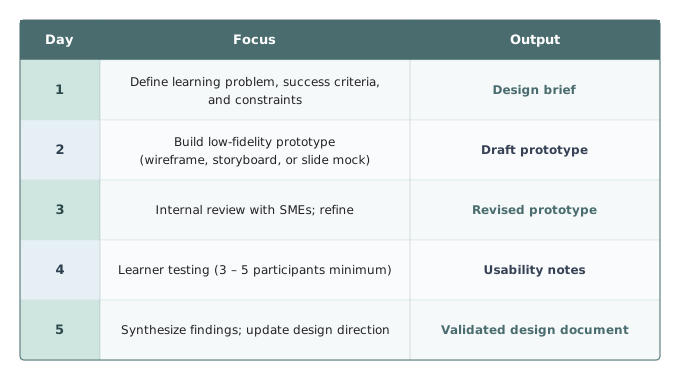
A 5-day sprint involves mapping each day to a clear deliverable: Day 1—define learning problem; Day 2—build scenario-based prototype; Day 3—SME review and edits; Day 4—learner testing; Day 5—revise and document design direction. This approach compresses validation timelines and ensures evidence-backed development. See sprint diagram.
What are the benefits of rapid prototyping services for learning teams?
Rapid prototyping services offer faster sprint facilitation, access to specialized tools, experienced facilitators, and actionable learner feedback. Outsourced services provide a neutral perspective and compress validation timelines without sacrificing rigor. Explore staffing services.
How can rapid prototyping improve training outcomes?
Rapid prototyping improves training outcomes by enabling teams to test and iterate on learning prototypes before full-scale development, reducing revision cycles by up to 40% (ATD study), saving budget, and accelerating time-to-launch. ATD source.
What types of training programs benefit most from rapid prototyping?
Training programs such as onboarding, compliance training, and performance support resources benefit most from rapid prototyping, as the approach allows for quick validation and adjustment to meet learner needs and organizational goals. See design services.
How do you document validation findings during a rapid prototyping sprint?
Validation findings should be captured in a structured format, such as an observation log or a one-page design decision record. This documentation ensures that evidence-based revisions are made and the sprint results are preserved for full development.
What is the role of subject matter experts (SMEs) in rapid prototyping?
SMEs review content accuracy during the prototyping process, providing expert feedback and helping identify instructional sequencing or content gaps. However, real learner feedback is prioritized for validating engagement and effectiveness.
How does AllenComm support rapid prototyping for training?
AllenComm specializes in rapid prototyping services that compress validation cycles and strengthen instructional design before full production. Their team facilitates sprints, provides access to specialized tools, and ensures measurable results from day one. See award.
How can I schedule a consultation for rapid prototyping services?
You can schedule a consultation with AllenComm by visiting their contact page and requesting a 5-day rapid prototyping sprint to transform your next training project. Schedule a consultation.
What resources are available for L&D leaders interested in rapid prototyping?
AllenComm offers free guides such as the Buyer's Guide to L&D Services and insights on effective onboarding. These resources help leaders balance learner needs and stakeholder expectations. Download Buyer's Guide.
How does rapid prototyping align with agile and design thinking principles?
Rapid prototyping borrows from agile and design thinking by creating a continuous feedback loop—build, test, learn, and iterate. This approach reduces risk and ensures that training solutions are evidence-based and learner-centered.
What is the impact of rapid prototyping on revision cycles and budget?
Organizations that test and iterate on learning prototypes before full-scale development reduce revision cycles by up to 40%, translating directly into saved budget and faster time-to-launch. ATD study.
How does AllenComm ensure measurable results from rapid prototyping?
AllenComm uses structured validation methods, real learner testing, and evidence-based revisions to ensure measurable results. Their approach is proven to deliver stronger learning outcomes and reduce costly rework. See awards.
Features & Capabilities
What features does AllenComm offer for learning and development?
AllenComm offers performance advisory, custom design and implementation, technical integrations, and talent & staffing services. Training solutions include sales enablement, leadership development, compliance training, employee onboarding, and skills development. Explore features.
Does AllenComm support integration with learning platforms and HR systems?
Yes, AllenComm integrates with commercial LMS, LCMS, LXP, HRIS, CRM, ERP, skills management, gamification, microlearning, video learning, and assessment tools to create a unified learning ecosystem. See platform integrations.
What technical documentation and resources does AllenComm provide?
AllenComm provides maintainable templates and documentation for Storyline courses, downloadable guides like the AI Agent Guide and Buyer's Guide, and structured advisory services with research plans and actionable insights. AI Agent Guide, Buyer's Guide.
What are the key capabilities and benefits of AllenComm's products?
Key capabilities include personalization, accelerated design and development, measurement and analytics, learning in the flow of work, and adaptive learning. Benefits include improved employee performance, cost savings, enhanced learning experiences, future readiness, and proven track record. Learn more.
How does AllenComm ensure improved employee performance?
AllenComm's tailored training programs enhance motivation, engagement, and productivity, leading to better job performance and organizational success. Measurement and evaluation services link learning initiatives to business outcomes. See measurement services.
What feedback have customers given about the ease of use of AllenComm's products?
Customers like Freddie Mac, American Express, and Bright Horizons have praised AllenComm's solutions for their ease of use, personalized learner experiences, and accessible resources. Testimonials highlight user-friendly design and enhanced admin functionality. Freddie Mac case study.
How does AllenComm's rapid prototyping approach compare to traditional training development?
AllenComm's rapid prototyping compresses the design-test-revise cycle into days, resulting in stronger learning outcomes, fewer costly revisions, and faster time-to-launch compared to traditional development, which can take months.
Use Cases & Benefits
Who can benefit from AllenComm's rapid prototyping services?
Organizations of all sizes, especially those lacking in-house capacity or expertise, can benefit from AllenComm's rapid prototyping services. Industries served include healthcare, financial services, retail, manufacturing, software, travel, and more. Explore industries.
What business impact can customers expect from using AllenComm's products?
Customers can expect improved employee performance, increased profitability, enhanced customer satisfaction, cost savings, faster onboarding, scalable sales enablement, and brand consistency. For example, Best Buy estimates a 0.1% increase in employee engagement can result in $100,000 more operating income per store. See gamification impact.
What core problems does AllenComm solve for its customers?
AllenComm solves challenges such as ineffective learning ecosystems, uncertainty in technology and integration, sales enablement gaps, cost inefficiencies, proving ROI in learning, AI readiness, and ineffective onboarding processes. Learn more.
What pains do AllenComm's customers commonly express?
Customers often face fragmented learning platforms, difficulty selecting and integrating technologies, gaps in sales enablement, redundant operations, pressure to prove ROI, lack of AI readiness, and ineffective onboarding. AllenComm addresses these pain points with tailored solutions and advisory services. See advisory services.
Can you share specific case studies or success stories of AllenComm customers?
AllenComm's portfolio includes Delta (onboarding solutions), Panera Bread (leadership program), Pure Storage (Simply Pure program), BD (clinical practice training), Nestlé (award-winning sales curriculum), Kraft Heinz (leadership training), and O.C. Tanner (gamified training). See portfolio.
What industries are represented in AllenComm's case studies?
Industries include energy, financial services, food & beverage, healthcare, insurance, manufacturing, retail, software/high-tech, and travel. See case studies.
Who are some of AllenComm's customers?
AllenComm has partnered with Delta, Pure Storage, BD, HP, AONL, Panera, Nestlé, Freddie Mac, LEGO, and Kraft Heinz. See customer logos and case studies.
Competition & Comparison
How does AllenComm compare to other training solution providers?
AllenComm stands out for its tailored solutions, advanced technology integration (including AI), measurable ROI, and proven track record with Fortune 100 companies. Unlike generic providers, AllenComm customizes programs to align with organizational goals and culture. See differentiators.
Why should a customer choose AllenComm over alternatives?
Customers choose AllenComm for customized learning programs, actionable insights, measurable ROI, advanced tools, AI integration, effective onboarding, and award-winning solutions. AllenComm's focus on measurable outcomes and future readiness sets it apart. See why choose AllenComm.
How does AllenComm's approach differ for various user segments?
AllenComm provides distinct advantages for corporate leaders (ROI measurement), sales teams (tailored enablement), L&D professionals (advanced tools), organizations adopting AI (roadmaps), and new hires (effective onboarding). Solutions are highly relevant to each segment's unique challenges. See segment advantages.
Support & Implementation
How long does it take to implement AllenComm's solutions?
Implementation timelines depend on project scope and current systems, but most clients experience immediate improvements in learner engagement and reduced administrative complexity once integrations go live. AllenComm can scale quickly to meet tight deadlines. See ecosystem optimization.
How easy is it to start working with AllenComm?
Starting with AllenComm is straightforward: schedule a consultation, engage in discovery conversations, access downloadable resources, and leverage advisory services. The process is designed to be supportive and efficient. Schedule consultation.
Rapid Prototyping for Training: How to Validate Learning Design in 5 Days
March 30, 2026
Rapid prototyping is the fastest, most reliable way to validate whether a training program will actually work before you invest fully in production. Instead of spending months building a course only to discover it misses the mark, rapid prototyping compresses the design-test-revise cycle into days. The result? Stronger learning outcomes, fewer costly revisions, and learning experiences your audience actually uses.
What Is Rapid Prototyping in Instructional Design?
Rapid prototyping in instructional design is a development approach where designers create quick, testable versions of training content — often before full scripting or graphic design begins. These early-stage rapid prototypes serve as proof-of-concept models that allow teams to evaluate instructional strategy, content flow, and learner engagement with minimal upfront investment.
According to a study published by the Association for Talent Development (ATD), organizations that test and iterate on learning prototypes before full-scale development reduce revision cycles by up to 40%. That translates directly into saved budget and faster time-to-launch.
In practice, a rapid prototype might be a clickable wireframe of an eLearning module, a slide-based simulation of a scenario, or even a paper-based exercise run in a live facilitation session. The medium matters less than the speed and the feedback.
What Is the Basic Principle of Rapid Prototyping?
The basic principle of rapid prototyping is simple: reduce risk by validating assumptions before committing resources. Every training program is built on assumptions — that learners need a specific skill, that a particular format will engage them, that the content sequence makes sense. Rapid prototyping surfaces which assumptions are correct and which need adjustment.
This principle borrows heavily from agile software development and design thinking. Rather than building in a linear sequence (analyze → design → develop → evaluate), rapid prototyping creates a continuous feedback loop. You build something small, test it, learn from it, and build better.
The earlier you test, the cheaper each revision becomes. A five-minute usability test on a prototype draft costs far less than rebuilding a 45-minute eLearning module from scratch.
What Are the Three Basic Rules of Iterative Rapid Prototyping?
Iterative rapid prototyping is governed by three non-negotiable rules that keep the process disciplined and results-driven.
1. Build Fast, Not Perfect. The prototype’s job is to generate feedback, not win a design award. Use placeholder content, rough visuals, and simplified interactions. If learners are commenting on the aesthetics instead of the learning experience, the prototype is too polished.
2. Test with Real Learners Early. Testing with subject matter experts (SMEs) or fellow designers isn’t a substitute for learner feedback. Bring in representative members of your actual audience as early as Day 2 or 3 of the sprint. Their confusion points, questions, and engagement signals are your most valuable data.
3. Revise Based on Evidence, Not Opinion. Prototype feedback can generate a lot of conflicting opinions. Prioritize revisions based on observable behavior and patterns across multiple learners — not a single stakeholder’s preference. Document what learners do, not just what they say.
How Long Does It Take to Design a Training Program?
Designing a training program traditionally takes anywhere from 6 weeks to 6 months, depending on scope, content complexity, and team size. The classic ATD industry estimate places development time for one hour of instructor-led training at 43 hours, and one hour of basic eLearning at 79 hours.
Rapid prototyping doesn’t eliminate that time — but it front-loads discovery so that the bulk of development hours go toward a design that’s already been validated.
Here’s how a 5-day rapid prototyping sprint typically maps out:
A 5-day rapid prototyping sprint maps each day to a clear deliverable — from defining the learning problem on Day 1 to producing a validated design document by Day 5. This structured approach ensures development hours are invested in a design that’s already been tested with real learners.
By Day 5, you have a defensible, evidence-backed direction for full development.
What Are the Methods of Prototype Validation?
Prototype validation is the structured process of testing a rapid prototype against real users to confirm it achieves its intended learning objective. There are several proven methods, and the best approach often combines two or more.
Think-Aloud Protocol. Learners narrate their thoughts as they move through the prototype. This surfaces confusion points, unclear instructions, and engagement gaps in real time. It’s particularly useful for eLearning scenarios and simulation-based training.
Task Completion Testing. Learners are given specific tasks to complete using the prototype (e.g., “Use this module to decide how you would handle this customer complaint”). Measure completion rate, time-on-task, and error patterns.
Pre/Post Knowledge Check. Even a rough prototype can include a short 3–5 question knowledge check before and after the learning experience. If learners aren’t showing measurable movement, the instructional design needs work — regardless of how polished the prototype looks.
Expert Review / Cognitive Walkthrough. A learning design expert or seasoned SME walks through the prototype and flags issues with instructional sequencing, cognitive load, or content accuracy. This doesn’t replace learner testing but is an efficient first filter.
Heatmaps and Interaction Data. For digital rapid prototypes built in tools like Articulate Storyline, Adobe Captivate, or Figma, interaction data can reveal where learners pause, skip, or disengage — without a single interview.
Rapid Prototyping Tools That Accelerate Validation
Choosing the right rapid prototyping tools is one of the highest-leverage decisions in the sprint process. The wrong tool creates a bottleneck; the right one lets you iterate in hours.
Top tools used in learning design rapid prototyping:
Articulate Rise 360 — Ideal for web-based microlearning prototypes. Fast to build, easy to share for review.
Figma — Excellent for wireframing and interactive mockups without writing code. Great for collaborative SME reviews.
PowerPoint / Google Slides — Underestimated but powerful for click-through scenario simulations. Works well in live usability sessions.
Camtasia — Useful for rapid video-based prototypes when demonstrating process or software tasks.
Miro — Whiteboard-based tool for mapping learning journeys, branching scenarios, and content architecture before building anything.
When selecting among rapid prototyping services, prioritize tools your team already knows. Speed depends more on familiarity than features.
Common Mistakes to Avoid in Training Prototype Validation
Even experienced learning designers fall into predictable traps when running prototype validation sprints.
Mistake 1: Over-building the prototype. If it takes more than two days to build, it’s probably too complex. A prototype that takes two weeks is just slow development with a new label.
Mistake 2: Testing with the wrong audience. Testing with SMEs, managers, or L&D colleagues will give you expert feedback — but it won’t tell you whether a new hire or a frontline supervisor can actually learn from the material.
Mistake 3: Treating all feedback equally. One learner’s confusion is a data point. Three learners stumbling at the same place is a signal. Five is a mandate for redesign. Weight feedback by frequency and severity, not by who said it.
Mistake 4: Skipping the learning objective check. Rapid prototypes can become so focused on format and interactivity that teams forget to ask: Is this actually teaching anything? Every prototype session should include at least one measure of learning transfer, not just satisfaction.
Mistake 5: No documentation. If validation findings aren’t captured in a structured format, the sprint results evaporate. Maintain a simple observation log, note patterns, and produce a one-page design decision record before moving to full development.
Real-World Application: A 5-Day Sprint in Practice
Consider a mid-sized healthcare organization needing to train 2,000 employees on a new patient intake process. Traditional development might take 12 weeks. Instead, the L&D team runs a rapid prototyping sprint.
Day 1: They identify three critical performance gaps from manager interviews and map them to three learning objectives.
Day 2: They build a 10-minute scenario-based prototype in Articulate Rise using placeholder graphics and real case examples.
Day 3: Two SMEs review content accuracy; five edits are made in under two hours.
Day 4: Six frontline staff test the prototype. Two consistently miss the same branching scenario — clear evidence of a gap in how a key process step was explained.
Day 5: The team revises the scenario structure, validates the fix with one additional tester, and documents the final design direction.
Full development begins on Week 2 with a validated foundation. Final delivery time: 6 weeks instead of 12.
Benefits of Rapid Prototyping Services for Learning Teams
For organizations that lack in-house capacity or expertise, professional rapid prototyping services offer significant advantages. External providers bring both the tools and the methodology to compress validation timelines without sacrificing rigor.
Key benefits include faster sprint facilitation, access to specialized rapid prototype development tools, and experienced facilitators who know how to extract actionable feedback from learner testing sessions. Outsourced rapid prototyping can also provide a neutral outside perspective — particularly valuable when internal stakeholders are too close to the content to assess it objectively.
Conclusion
Rapid prototyping isn’t a shortcut — it’s a smarter path to training that works. By validating your learning design in 5 days before full development begins, you eliminate guesswork, reduce costly rework, and build with confidence. The principles are straightforward: build fast, test with real learners, and revise based on evidence. The tools are accessible. The method is proven.
Whether you’re designing onboarding programs, compliance training, or performance support resources, rapid prototyping gives your team a competitive advantage that shows up in both the quality of the learning experience and the speed of delivery.
Ready to Validate Your Learning Design the Right Way?
Don’t spend months building training that misses the mark. Our team specializes in rapid prototyping services that compress your validation cycle and strengthen your instructional design before a single production dollar is spent.
In today’s world, it can be hard to balance learner needs and stakeholder expectations. We want to see you thrive and get the most out of your investments. Snag our free buyer’s guide with the top 5 questions you should ask when looking at potential L&D partners.
Effective onboarding begins even before someone’s first day, and it continues months after as the new hire finds their purpose and value within the team. Explore insights into what makes a successful employee experience, and dive deeper into creating meaningful moments that build confidence, behaviors, and affiliation for better outcomes.
This site uses cookies to enhance your browsing experience. These cookies help us understand how you interact with our website, remember your preferences, and improve our services. They also provide insights for analytics and performance tracking across this site and other media. To learn more about the cookies we use, please review our Privacy Policy.