Why is engaging leadership critical for successful learning and development initiatives?
Engaging leadership is essential because leaders set the tone for organizational learning, allocate resources, and drive buy-in for new initiatives. As discussed in AllenComm's podcast with Gina Montefusco of UnitedHealth Group, involving leadership early ensures alignment with business goals, helps overcome resistance, and enables scalable innovation in L&D. Leaders who are engaged can champion new approaches and support proactive, data-driven decision-making. Source
What practical strategies can L&D teams use to engage leadership?
Practical strategies include understanding executive needs, involving leaders as much as they desire, using employee and learner data to inform decisions, and building large stakeholder groups for feedback. Gina Montefusco recommends tailoring communication to each leader, using data to show what works, and involving stakeholders early to ensure initiatives resonate across the organization. Source
How can L&D teams balance innovation with standardization in large organizations?
Balancing innovation with standardization requires understanding organizational culture, being open to new approaches, and recognizing when to compromise for scale. In healthcare, for example, standard practices are common, but innovation is possible by piloting new ideas, gathering feedback, and scaling what works. Gina Montefusco suggests "harvesting resistance" to learn from concerns and using pilot programs to test innovations before broad rollout. Source
What role does data play in driving proactive L&D strategies?
Data is crucial for moving from reactive to proactive L&D strategies. By collecting and analyzing learner and stakeholder feedback, teams can demonstrate what works, justify investments, and avoid discarding effective practices for the sake of new trends. Data-driven decision-making helps L&D teams engage leadership with evidence and plan for long-term success. Source
How can resistance from leadership or teams be used constructively in L&D projects?
Resistance can be a valuable source of feedback. By "harvesting resistance," L&D teams can identify concerns, address potential pitfalls, and refine their strategies. Engaging with skeptics early and incorporating their input helps ensure that new initiatives are relevant, scalable, and more likely to succeed. Source
What questions should L&D leaders ask stakeholders before launching a new project?
L&D leaders should ask: Why is this project needed now? What does success look like in 6-12 months? What barriers might we face? What data is needed to measure success? These questions help clarify goals, align expectations, and ensure that training solutions address real business needs. Source
How can L&D teams scale innovation across large organizations?
Scaling innovation requires piloting new ideas with smaller groups, gathering feedback, and then expanding successful initiatives. Building relationships with key leaders, using data to demonstrate value, and involving large stakeholder groups in content review are effective strategies. For example, UnitedHealth Group used a gamified course with 10,000 pilot users before launching to 200,000 employees. Source
What mindset helps L&D teams succeed in large, complex organizations?
A growth mindset focused on continuous improvement, openness to feedback, and willingness to "keep trying" is key. Teams should acknowledge the need for compromise at scale but remain committed to innovation and relationship-building. As Gina Montefusco notes, even moving one VP can impact thousands of employees. Source
How can L&D teams use technology to enhance learning experiences?
Leveraging modern platforms like LMS and LXP can create more equitable and engaging learning experiences. UnitedHealth Group, for example, rolled out a new LMS and LXP, using gamified courses to drive adoption and encourage exploration beyond compliance training. Technology should be used to support both push (assigned training) and pull (self-directed learning) strategies. Source
What are the advantages of using gamification in large-scale learning initiatives?
Gamification increases engagement, encourages sharing, and can drive viral adoption of learning platforms. In UnitedHealth Group's experience, a gamified course launch led to over 30% of new users exploring additional content, with executive endorsement further boosting participation. Source
How can L&D teams ensure technology investments are fully utilized?
Teams should explore the full capabilities of their LMS and LXP platforms, beyond basic compliance training. AllenComm recommends collaborating with vendors, conducting regular reviews, and encouraging experimentation to maximize platform value. Most organizations use only a fraction of their technology's potential, so ongoing education and partnership are key. Source
What lessons can be learned from scaling L&D in healthcare organizations?
Healthcare organizations often require balancing strict standards with the need for innovation. Lessons include piloting new approaches, engaging large stakeholder groups, using data to drive decisions, and leveraging technology to reach all employees. UnitedHealth Group's experience shows that even in highly regulated environments, innovation is possible with the right mindset and strategies. Source
How can L&D teams create a culture of continuous learning?
Creating a culture of continuous learning involves leadership support, proactive planning, and leveraging technology to make learning accessible and engaging. Encouraging reflection, sharing success stories, and providing opportunities for feedback all contribute to sustained growth and innovation. Source
What advice would experienced L&D leaders give to their younger selves?
Experienced leaders like Gina Montefusco advise stepping into L&D opportunities earlier, embracing challenges, and not holding back due to uncertainty. The journey, including diverse experiences, shapes effective leadership and innovation in L&D. Source
How can L&D teams design projects for both small and large organizations?
Whether working with small teams or scaling to hundreds of thousands, the key is to design for stakeholder involvement, pilot new ideas, and use feedback loops. Even small teams can innovate by leveraging project management best practices and involving external partners when needed. Source
What resources does AllenComm offer for L&D leaders?
AllenComm provides free guides such as the Buyer's Guide to L&D Services and onboarding resources, as well as a podcast series, blog insights, and case studies. These resources help L&D leaders make informed decisions, plan effective onboarding, and stay current with industry trends. Buyer's Guide | Onboarding Guide
How does AllenComm support onboarding for hybrid and remote teams?
AllenComm offers insights and guides on creating consistent onboarding experiences for hybrid teams, ensuring that both remote and in-office employees receive effective training and support. Their resources address the complexities of onboarding across time zones and work environments. Read more
What is rapid prototyping in training, and how does AllenComm approach it?
Rapid prototyping is a method for quickly validating learning design concepts before full-scale production. AllenComm provides guidance on how to test and iterate training programs in as little as five days, reducing risk and ensuring alignment with learner needs. Learn more
What training metrics should organizations track beyond completions?
Organizations should track metrics such as learner engagement, knowledge retention, behavior change, and business outcomes. AllenComm's blog highlights the importance of measuring impact beyond course completions to ensure training effectiveness. Read more
AllenComm Features & Capabilities
What features does AllenComm offer for learning and development?
AllenComm offers performance advisory, custom design and implementation, technical integrations (including AI-driven adaptive learning), and talent & staffing services. Their solutions include sales enablement, leadership development, compliance training, onboarding, and skills development, all tailored to organizational needs. Learn more
What platform integrations does AllenComm support?
AllenComm integrates with a wide range of platforms, including commercial LMS, LCMS, LXP, HRIS, CRM, ERP, skills management, gamification, microlearning, and video learning tools. These integrations create a unified and seamless learning ecosystem. Details
What technical documentation and resources does AllenComm provide?
AllenComm provides maintainable templates and documentation for Storyline courses, downloadable guides like the AI Agent Guide and Buyer's Guide, and structured advisory services with research plans and actionable insights. AI Agent Guide | Buyer's Guide
How does AllenComm measure the ROI of learning initiatives?
AllenComm offers measurement and evaluation services that link learning initiatives to business outcomes, helping organizations justify their L&D investments and demonstrate tangible results. Learn more
What business impact can customers expect from AllenComm solutions?
Customers can expect improved employee performance, increased profitability, enhanced customer satisfaction, cost savings, faster onboarding, and measurable sales enablement. For example, Best Buy found that a 0.1% increase in employee engagement led to a $100,000 increase in operating income per store. Source
How does AllenComm support future readiness and AI integration?
AllenComm integrates emerging technologies like AI into learning ecosystems, providing roadmaps for AI readiness, personalized learning, and advanced analytics to ensure organizations are prepared for future challenges. Explore AI Readiness
What industries does AllenComm serve?
AllenComm serves industries including healthcare, financial services, retail, manufacturing, software, travel, energy, insurance, and food & beverage. Their case studies showcase expertise across these sectors. See portfolio
Who are some of AllenComm's customers?
AllenComm has partnered with leading companies such as Delta, Pure Storage, BD, HP, AONL, Panera, Nestlé, Freddie Mac, LEGO, and Kraft Heinz. See case studies
What feedback has AllenComm received regarding ease of use?
Customers such as Freddie Mac, American Express, and Bright Horizons have praised AllenComm for creating user-friendly, accessible training solutions. Testimonials highlight simple LMS interfaces, enhanced admin functionality, and resources available at the touch of a button. Freddie Mac Case Study
How long does it take to implement AllenComm solutions?
Implementation timelines depend on project scope and current systems, but most clients see immediate improvements in engagement and reduced administrative complexity once integrations go live. AllenComm's large in-house team enables rapid scaling and efficient project starts. Learn more
What problems does AllenComm solve for its customers?
AllenComm addresses challenges such as ineffective learning ecosystems, technology integration uncertainty, sales enablement gaps, cost inefficiencies, proving ROI, AI readiness, and onboarding difficulties. Their solutions are tailored to each organization's needs. Learn more
How does AllenComm compare to other L&D solution providers?
AllenComm differentiates itself through tailored solutions, advanced technology integration (including AI), measurable ROI, and a proven track record with Fortune 100 companies. They focus on customization and measurable outcomes, unlike many off-the-shelf providers. See details
Who can benefit from AllenComm's solutions?
Corporate leaders, sales teams, L&D professionals, organizations adopting AI, and companies with high onboarding needs can all benefit from AllenComm's tailored solutions. Their offerings are relevant across industries and company sizes. Learn more
Can you share specific case studies or success stories?
Yes, AllenComm's portfolio includes success stories with Delta (scaling onboarding), Panera Bread (leadership development), Pure Storage (innovative learning), BD (clinical training), Nestlé (award-winning sales curriculum), and more. See case studies
Episode 23: How to Engage Leadership: Practical Strategies to Innovate, Scale, and Be Proactive in L&D
July 22, 2025
Every industry has its own unique L&D challenges and opportunities. In healthcare, there’s a critical intersection between innovation and learning that, when embraced right, can be a valuable tool to improve outcomes. In this episode, Ron Zamir meets with Gina Montefusco, Sr. Director of Culture and Strategic Initiatives at UnitedHealth Group, to explore what it means to innovate and scale for a large healthcare organization—while engaging leadership, enhancing technology, and employing practical project planning strategies to make an impact.
Top Takeaways
Gina’s journey from nursing to learning leadership showcases the importance of diverse experiences.
Scaling innovation in healthcare requires balancing standard practices with new approaches.
Engaging leadership is crucial for successful learning initiatives.
Data-driven decision-making helps in navigating reactive expectations.
Resistance can be a valuable source of feedback for improvement.
Proactive planning is essential for effective project management.
Understanding the end goals of training is key to success.
Leveraging technology can enhance learning experiences significantly.
Creating a culture of continuous learning is vital for organizational growth.
Reflecting on past experiences can guide future career decisions.
Gina Montefusco: Senior Director of People Development, UnitedHealth Group
Gina Montefusco is the Senior Director of People Development and an executive coach who’s passionate about helping people and organizations grow. With years of experience leading change and building learning strategies that stick, Gina brings a practical, people-first perspective to every conversation. She’s worked closely with AllenComm on several initiatives and is excited to share her journey and insights on this episode.
Ron Zamir
Welcome everybody to our session on innovation. This is one of the many podcasts we do to help our industry and our peers get tips and tricks and hear stories about how learning leaders are innovating in their practice.
I’m joined by Gina. She’ll introduce more of herself from the UnitedHealth Group. This is me, Ron Zamir, CEO of AllenComm. And we are going to spend the next 10, 20, 30 minutes really exploring how we innovate within our world and our practice.
So with that, Gina, I’m going to get us started. I am going to ask one of my favorite questions. What got you into this industry? And what has been your journey from wherever you started to where you are now?
Gina Montefusco
Yeah, thanks for having me. I’m really excited to be here today. So I am Gina Montefusco. I have the privilege of working in our enterprise learning group at UnitedHealth. And my journey has been a little kind of… I always say kind of windy, in that I started my career as a pediatric ER nurse and an ER nurse. I did that for 10 years.
I got into leadership, and I was saying I do… I wasn’t doing well. And when I was getting my masters, I got recruited into an OD team because they were looking for a clinician who could really speak to other clinicians. And I kind of said, well, I don’t know, I don’t know this whole leadership thing. And they said, we can teach you that. That was a turning point in my career. I had always thought I was going to be doing hospital administration. And that was a turning point for me. I fell in love with this opportunity to continue to help individuals grow, and for me it’s like, not make the same mistakes that I made.
I had the opportunity to work in that OD team and really learned a lot when it came to leadership. We did everything. We did leadership development, we did team development, we did individual development. And through that I ended up having an executive coach that then I said, my gosh, I want to do that.
So then I did executive coaching, I did that for a small time and then ended up in UnitedHealth Group. And I’ve been here for the last five years. It’s been like such this opportunity to scale things into ways like I never thought I would, and really think about pushing that envelope on how you build scalable and impactful content across.
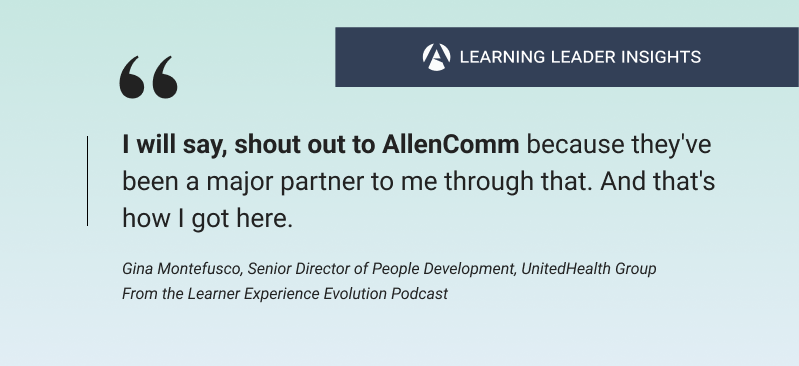
I will say, you know, shout out to AllenComm because they’ve been a major partner to me through that. And that’s how I got here.
Ron Zamir
Your journey is actually very logical. Those of you that have heard this before, I started as an archaeologist in the beautiful old city of Jerusalem, and luckily the military straightened me out and got me into instructional design. So there’s a lot of curves in the journey to do part of what we’re all passionate about is impact people, processes, and behaviors.
UnitedHealth Group is, I think, for over 400,000 employees. So let’s dig into that because you kind of represent the place, okay, how do I scale? How do I innovate? Share with me some of the tensions, if at all, that exist between scale and innovation and how you manage those processes in your job.
Gina Montefusco
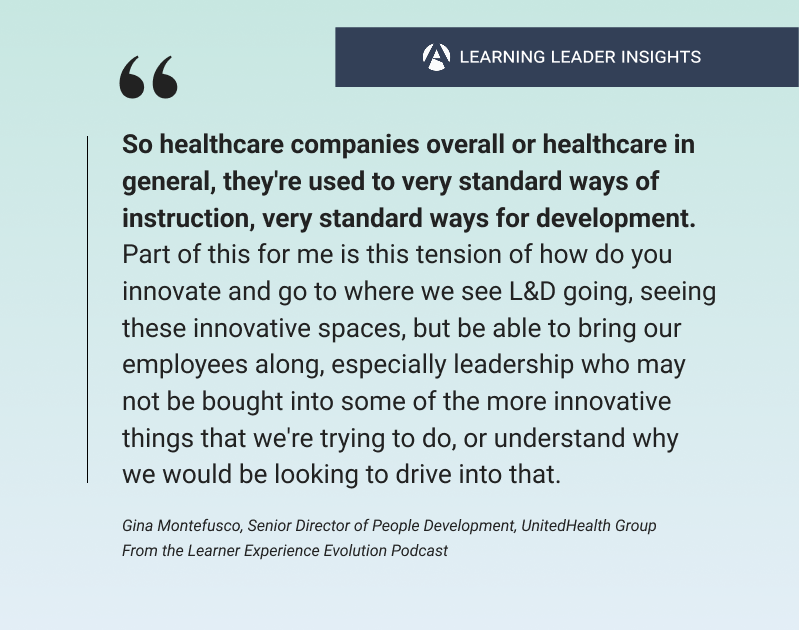
Yeah, when I think about like scale and innovation, and then part of being part of a healthcare company. So healthcare companies overall or healthcare in general, they’re used to very standard ways of instruction, very standard ways for development, skill, awarding, skill. They also are good with technological platforms that don’t work.
So part of this for me is this tension of how do you innovate and go to where we see L&D going, seeing these innovative spaces, but be able to bring our employees along, especially leadership who may not be bought into some of the more innovative things that we’re trying to do, or understand why we would be looking to drive into that.
Ron Zamir
Yeah, a big theme of our discussions, and I would love your reaction to, is how do we move from being reactive to proactive, right? To innovate, you can receive and say, hey, I want AI and everything, now go do it. Or they can say the opposite, I don’t want any AI, and you say, well, here’s what I can do in it. So talk a bit about your experiences on being able to navigate that reactive expectation and turn that into a proactive role for yourself and your team.
Gina Montefusco
Yeah, I think for me in that a lot of our especially big corporate places can be very reactive, right? Some executive comes in, they now want this or that. And now it’s to say jump. When I think about that, I think that it’s our role to spend the time to understand what that means, the impact to our teams, what we can really gain from that, and really engage in dialogue with our leaders to help them make a better, not always a better decision, but to not be as reactive.
The other thing for me is like, how do we show data on what is working so that we don’t throw out what we know works just because this new thing is coming down the pike? And that’s how… that’s a lot of times how I try to balance and I challenge my team in that. That also means that we have to keep up with what’s coming so that I’m not blindsided by that request.
Ron Zamir
Yeah. You know, it’s always a dilemma for me how as a vendor, we tend to be brought in to push our clients a bit out of their comfort zone. And there’s that thin border when it’s too much, right? When you work with your partner to do something they’ve never done before, but it’s too much for their leadership or for their SMEs or even through their internal team versus pushing to the edge and a bit beyond so they can be more innovative.
How often do you encounter that in your work? And it doesn’t have to be with AllenComm, with anybody, in getting out of your comfort zone or not getting out too much.
Gina Montefusco
I mean, I think for me, I try to put myself in that space. How can I do that or be open-minded to that? I grew up, you know, my career as a nurse, we’re really great at finding all the reasons why we shouldn’t do something. So for me, I personally challenge myself to like, I need to identify those to feel good. And how do I push through that? And that’s at that reactive proactive thing that you already mentioned, right?
The way I like to think about that is like, here’s your great idea. Let’s figure out what could go wrong with that before we do it, and then let’s kind of lean into it where it makes sense and push the boundaries. I think for me, it’s often this challenge to the scale at which we operate. To me, it creates this huge space to really push the envelope.
I think for some people, it can also though make them very reactive because we are a slow ship to steer. And so my push often is like, let’s give it a trial. Like, let’s give it three months. Let’s give it six months. You can’t just after one month say something doesn’t work.
Ron Zamir
And it’s natural. All these customers of ours that are over, let’s say even over 50,000, we won’t even go to 400,000. Scale does necessitate some level of compromise in being very… you can’t punch through like you would if you had a small team, if you were like… a lot of our customers are leadership leaders. They have to work with 100 top leaders. It’s different than having now to scale something across hundreds of thousands of people.
But you can still innovate, right? You can still scale. And I think that mindset that you’re describing is something that’s so valuable in our industry, because we do get beat down a bit. I apologize for using kind of a harsh term. Governance models beat us down. New executives, they don’t want to beat us down, but they kind of give us new information when we weren’t expecting it.
Talk a bit more about the mindset, and when you have to advise a new team member, how do you find the mindset that you want on your team so you can scale and innovate?
Gina Montefusco
Yeah, I think the mindset for me is partially like, let’s keep trying. And I think we have to acknowledge sometimes what we do have to give up for scale. I mean, there are things that we have to give up.
Like I truly believe and love doing leadership development or programmatic content in which I can go with a small group of individuals and really shepherd them through something. That’s why I’m a coach. And how do I push the mindset to say, yeah, but we have this opportunity to impact 400,000 people who then impact, you know… the numbers are staggering when you think about then those people who we interact with, and who our company has influence on when we think about the American healthcare system, which is fraught with a lot of good things and bad things.
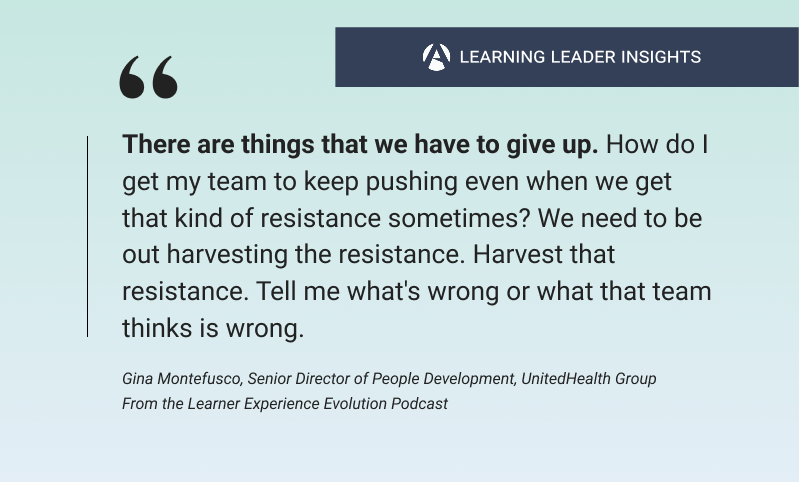
But it’s how do I get them to keep pushing even when we get that kind of resistance sometimes? I sell my team all the time. We need to be out harvesting the resistance. Harvest that resistance. Tell me what’s wrong or what that team thinks is wrong.
The other thing for me is I operate sometimes like it is a small company because truthfully, if I can move one VP, they may have 5,000 employees. I mean, they’re the size of some companies. And so with that, it’s like, how do we still build relationship? How do we still just continue and get out and market what we do and know that it’s the right thing?
Ron Zamir
Yeah. I really like something you said, in my words, maybe not yours, is you’re embracing the challenges versus trying to weave away or between the challenges, right? So some people, as this is an old, sorry for my grandmother saying, she would say, well, you gotta know how to dance between the raindrops sometimes in life, but you’re actually letting those raindrops hit you, right, and then creating your own path through those raindrops.
We talked a lot about the teams, we talked a lot about the 400,000. Sometimes though it comes down to the leadership you have to engage with in order to bring them on board. Share some of the journeys you take with leadership and how that helps you reach that… pushing that envelope that you described and how you scale.
Gina Montefusco
I think for me and the way I operate, I work very hard to involve leaders as much as they want to, right? You have some VPs that just want to know, they think that, you know, Gina’s doing a great job, great, keep going. There are others who want more detail. And so for me, it’s taking the time to learn the executive to know what they need.
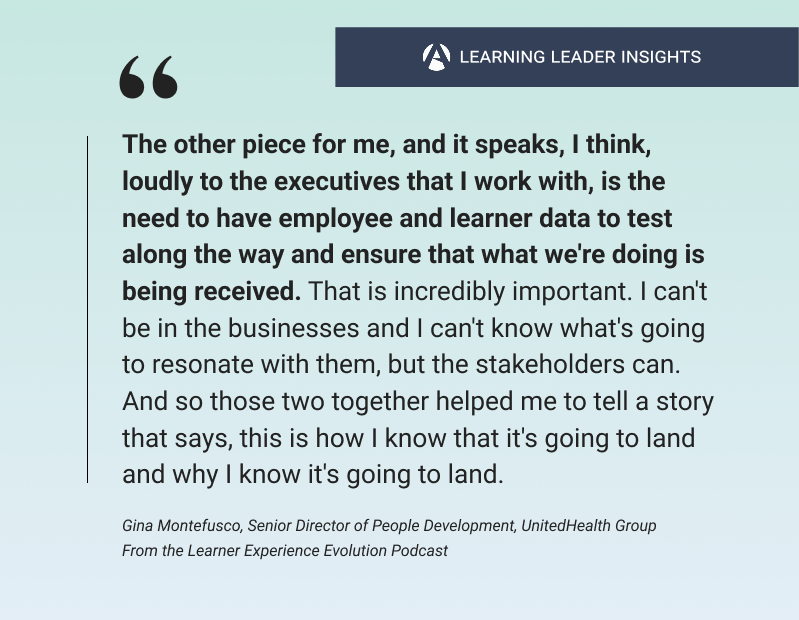
The other piece for me, and it speaks, I think, loudly to the executives that I work with, is the need to have employee and learner data to test along the way and ensure that what we’re doing is being received. Because when I have that information… so one of the ones that that course we were just talking about, which is this gamified course that got assigned to 200,000 people, we did multiple… I mean, 10,000 people probably took that course or had some part in that course before it ever launched. That also makes it feel like not a surprise.
And I use huge stakeholder groups. So for one course, I might have 40 to 45 people who are reviewers of the content. And for me, that is incredibly important. I can’t be in the businesses and I can’t know what’s going to resonate with them, but the stakeholders can. And so those two together helped me to tell a story that says, this is how I know that it’s going to land and why I know it’s going to land.
Ron Zamir
No, I love that and you piqued my curiosity because we all know how learning teams are usually squeezed. They’re not very people heavy, right? We, you know, to say the least. And I don’t want our listeners to think that if they’re a team of three, they can’t do any of this. But because the reality is most learning organizations are between two to twelve, right?
You bring up an issue because most… our experience is a lot of the learning groups, if you take away their day-to-day trainers that do the day-to-day work, which gives them a lot of size, right? They’re project managing, they’re getting asked and they’re figuring out how to do it, they do it with a vendor, without a vendor.
But you brought up something else is putting in your project management mindset, a SOP or strategy to test and pull in more people early on into the process. So it’s not just about designing and having a good intake so you know what your stakeholder wants. It’s actually designing scale in your own organization to be able to pull in people outside your organization. And that’s a very interesting skill set that we don’t meet as much.
I want to, hopefully that will come out strong when people listen to this. So that brings me to my next area, and I think we’ve touched on it. The next kind of journey or exploration I want to do with you here is now on the practical, because we alluded to it. When you are setting up your team members for success, when you are in those first steps of planning out the intake of a new project, hiring of a new vendor, that initial conversation with the stakeholder… What are some of the practical tools, tips, approaches you take that somebody now, imagine somebody now writing all this down. So I’m going to put you on. No, don’t imagine that, no.
Gina Montefusco
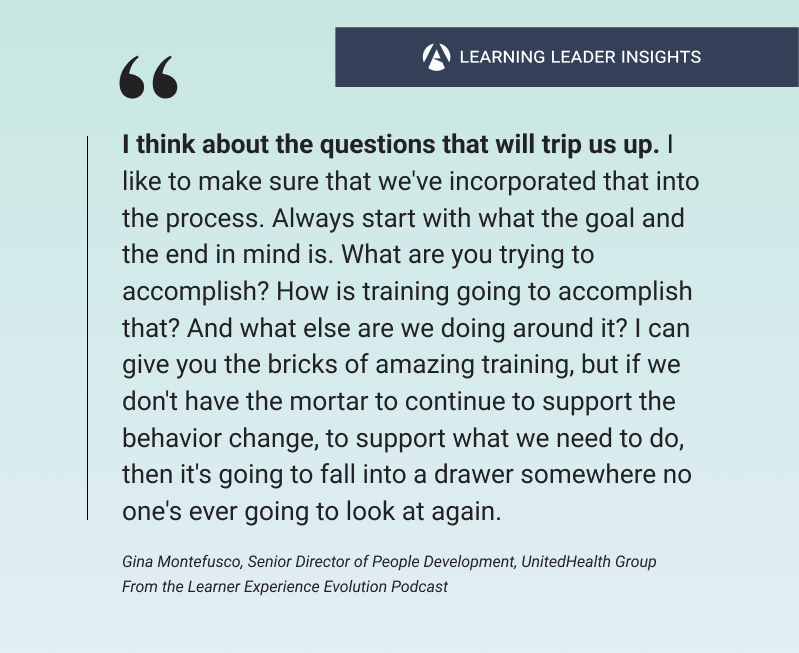
No, I can’t imagine that. But I mean, thinking about that, I love that you started with this like proactive reactive, because that’s a big way that I like to operate in general. And so I think about the questions that will trip us up. I like to make sure that we’ve incorporated that into the process.
When I think about starting a journey, also really, really always start with what the goal and the end in mind is. You know, I always joke, and I’m sure a lot of us in training know, everybody wants training for something, but is it the right… is training the right solution?
So I like to get really clear with whoever is asking for it. What are you trying to accomplish? How is training going to accomplish that? And what else are we doing around it? Right? So sometimes we say like the bricks and the mortar. It’s like, I can give you the bricks of amazing training, but if we don’t have the mortar to continue to support the behavior change, to support what we need to do, then it’s going to fall into a drawer somewhere no one’s ever going to look at again. And so for me, those are the things I want to know before I even get the team really going.
Ron Zamir
Yeah, I think something I do when I get to review our projects is I like the why question. I mean, the how is something I’m never going to be as good as the professionals that work with me. They’re a lot better. And I have whole story about my first reaction when I was told about the animal characters in one of the projects we did. I did not react well to that. Haha, and it was very successful. That’s the secret.
So I’ve learned to be very accepting that I’m not as good as I was 20 years ago when it comes to this. But what I do still do, and I think that’s important for any leader when encountering a request, is to get out of that reactive mindset, is ask the why question. Understand that learning is at best one fourth or even one eighth of the change and the behavior impact you’re trying to create.
Almost have a checklist, right? Almost, you know, for yourself, create some mnemonics or even a list that helps you be a contrarian sometimes. And through that, distill some of the things that have to be done. What’s the critical path? When you get into that first conversation with a stakeholder, that’s, you know, you’ve been asked to do something, you know, something big, something small, it doesn’t matter. What are some of the questions you ask them that help them inform you of what needs to be done?
Gina Montefusco
I mean, some of them are those why questions. Why is this now? Why now? I like to always ask like, what does success look like? And, you know, six months, nine months, a year from now, again, really getting away from what they’re often coming and asking for and more into what’s important. The other piece is kind of a question around what’s important to you. What do you think gets in the way, or could get in the way?
Again, back to my reactive, proactive kind of approach, so that we have that there. What data do you need to know? Those are kind of the high level ones, but I like to just have a conversation first before it is this like, go make this course that does this thing. Because I need to know those things to make sure that I’m impacting and creating what they need.
Ron Zamir
Yeah, I’ve always thought that the best executives or managers let their team manage up to them. In other words, help them by asking the questions you ask, set the right parameters of how they will work together and make this successful.
Let’s switch a bit to technology. When you kind of look at what’s available to you or to your employees as they experience learning, what are some of the lessons you’ve learned by how to use technology? What works, what doesn’t work? What are some of the advantages or pitfalls in that area?
Gina Montefusco
Yeah, we’ve been on a big technological journey, as we started about in the beginning, healthcare can kind of be behind and you’re looking at LMS from the 1990s. So we have done a large scale and a commitment to our learning technology to create more equitable learning for all of our employees. We did in the last two years roll out a new LMS, a new LXP, which is like the new piece, right?
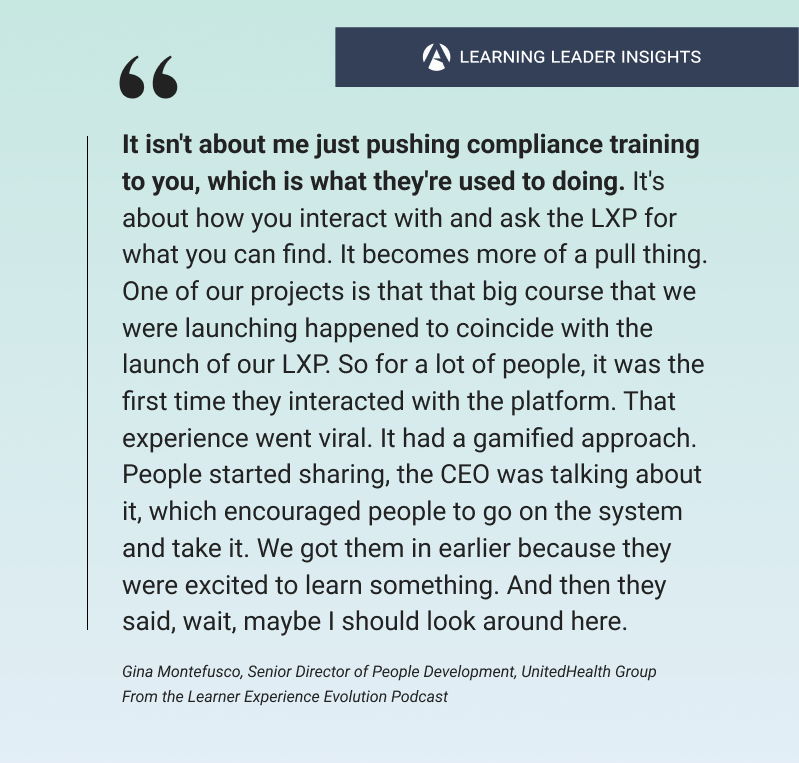
So now part of that is shifting our learners to go from… It isn’t about me just pushing compliance training to you, which is what they’re used to doing. It’s about how you interact with and ask the LXP for what you can find. It becomes more of a pull thing.
What I learned through one of our projects is that that big course that we were launching happened to coincide with the launch of our LXP. And we were able… and so I wasn’t playing this from the beginning, but one of those like happenstance things that like now I think is amazing and would love to replicate somewhere else, or things that it would, is that we launched that course, which was really one of the first learning experiences that was pushed out for a big initiative.
So for a lot of people, it was the first time they interacted with the platform. What we saw though is because that experience was… it went viral, that experience went viral. It had a gamified approach. People started sharing, the CEO was talking about it… like those, which encouraged people to go on the system and take it, right? Because you were going to be asked what your gamified thing was, right?
We saw that like something like over 30% of those like new people who engaged in the platform went on to look at something else. But there’s no promise that they would have gone in, you know, like they probably would have gone in when they had a compliance training, which would have happened eventually in the year, but we got them in earlier because they were excited to learn something. And then they said, wait, maybe I should look around here.
Ron Zamir
Yeah, and here I get to share one of my pet peeves because when we approach a project, we’ll always ask what technology, what’s your stack, we call it, education stack. And we try to encourage or fill in a gap. Do our customers who own these stacks, do they realize how powerful the tools they have are, and how they mesh with the design?
And I think that type of interaction is something we’re trying to do more of because I can tell you nine out of ten times, people that purchase these LXPs and LMSs are only using 10%, 20% of their capability. And that kind of a relationship with your vendors, but more important with your own time you get to spend on these platforms, is critical for success.
Anyway, we’re going to get to our last kind of segment, one of my favorite segments, but this has been great. And I hope viewers get a lot out of this, or listeners, depending how you see it.
So we’re now 2025. You started a while back. If things you know today, what would you tell yourself like 15, 20 years ago when you started this journey that would have made your journey faster, better, or more fun, or anything you would have told yourself then?
Gina Montefusco
I mean, I think part of what I would have told myself is step into this space. I mean, I stepped into this space a little bit later. I danced around it, right? I did this nursing and that’s a huge, you know, it’s a huge part of what makes me me today. And I love that. But I think had I known earlier, cause I’ve had, I had the passion, right? I did all this stuff with learning and like, what if I had kind of gotten and put myself out there earlier.
I think I held myself back a little bit in smaller companies and smaller things because I wasn’t sure and was kind of so stuck. So it makes me think about what if I had made a jump earlier than I did. And I also feel like I’m in the right place at the right time and I wouldn’t be here without all of that stuff I learned. So it’s a little bit of a mixed bag.
Ron Zamir
Well, I think I would say sometimes the journey is worth it. Maybe you don’t want to tell too much to your former self. Let them experience it. But that is great. Well, I’m going to kind of wrap it up. Again, thank you to those that listen or view our podcast. This is all about what you get from the peers we bring on or the professionals we bring on. So I really want to thank Gina for joining us and look forward to our next podcast. But with that,
I wish everybody goodbye and thank you for this podcast. Thank you, Gina.
Resources For L&D Leaders
free guide
a buyers guide to l&D services
In today’s world, it can be hard to balance learner needs and stakeholder expectations. We want to see you thrive and get the most out of your investments. Snag our free buyer’s guide with the top 5 questions you should ask when looking at potential L&D partners.
Effective onboarding begins even before someone’s first day, and it continues months after as the new hire finds their purpose and value within the team. Explore insights into what makes a successful employee experience, and dive deeper into creating meaningful moments that build confidence, behaviors, and affiliation for better outcomes.
This site uses cookies to enhance your browsing experience. These cookies help us understand how you interact with our website, remember your preferences, and improve our services. They also provide insights for analytics and performance tracking across this site and other media. To learn more about the cookies we use, please review our Privacy Policy.